
NICET guide · by a working life-safety tech · Updated October 2, 2026
NICET Certification Explained: Levels, Exams, and How to Pass
Everything a fire alarm, sprinkler, special hazards or ERCES technician needs to know about NICET in one place: the six fire protection programs, what Levels I through IV actually require, what the exam is like, which code editions are on it, what it costs, how recertification works, and a study plan that fits around a job. Written by someone who does the work and built the apps, not a content farm.
Exam lengths, experience requirements and fees come from the NICET Fire Alarm Systems Candidate Handbook (August 2026 edition), nicet.org/exams/references and nicet.org/recertify, checked October 2, 2026. NICET updates these, so confirm in the current handbook for your program before you apply. TapForge Studios is independent and not affiliated with NICET.
What NICET is, and who requires it
NICET is the National Institute for Certification in Engineering Technologies, a division of the National Society of Professional Engineers. It certifies engineering technicians, the people who install, inspect, test, lay out and manage systems, in subfields and levels. A NICET card says two things at once: you passed an exam written to the current codes, and you documented real work experience that a supervisor signed off on.
In fire protection it has become the credential the industry runs on. Many states, cities and authorities having jurisdiction (AHJs) tie fire alarm and sprinkler licenses, plan submittals and inspection sign-offs to a NICET level, often Level II for installation technicians and Level III for anyone whose name goes on a design. Plenty of employers require it even where the law does not, and pay scales usually step up with each level. The exact rule is local, so check your state fire marshal or licensing board.
The six fire protection programs
Pick the program that matches the work you actually do. The experience you document has to be in that work.
| Program | Levels | Who it's for | Our prep app |
|---|---|---|---|
| Fire Alarm Systems (FAS) | I – IV | Fire alarm installers, service techs, designers and project managers. The most widely required NICET credential. | Fire Alarm Prep |
| Inspection and Testing of Fire Alarm Systems (ITFAS) | I – II | Technicians whose job is the periodic inspection and testing of fire alarm systems under NFPA 72. | Fire Alarm ITM Prep |
| Water-Based Systems Layout (WBSL) | I – IV | Sprinkler system designers and layout technicians. Level III is two separate exams: General Plans, and Hydraulics & Water Supply Planning. | Fire Sprinkler Layout Prep |
| Inspection and Testing of Water-Based Systems (ITWBS) | I – III | Sprinkler, standpipe and fire pump inspectors working to NFPA 25. | Fire Sprinkler ITM Prep |
| Special Hazards Systems (SHS) | I – IV | Clean agent, carbon dioxide, foam and water mist system technicians. | Special Hazards Prep (coming soon) |
| In-Building Public Safety Communications (IB-PSC) | I – III, plus a separate Design track | ERCES / ERRCS technicians and designers: BDAs, DAS, signal boosters and the grid testing behind them. | ERCES Prep |
Levels I–IV, using Fire Alarm Systems as the example
Every program follows the same shape: Level I is a technician trainee working under supervision, Level II works with limited supervision, Level III works independently and leads, Level IV manages. Each step adds an exam, more documented experience and, from Level III, personal recommendations. Here is what Fire Alarm Systems requires as of the August 2026 handbook:
| Level | Exam | Experience (full-time equivalent) | Also required | Fee |
|---|---|---|---|---|
| I · Technician Trainee | 85 questions, 110 min | 6 months with fire detection and signaling systems | Supervisor verifies 5 performance measures | $235 |
| II · Associate Engineering Technician | 110 questions, 155 min | 2 years, at least 12 months of it on fire alarm systems (detection, notification, sprinkler monitoring, interfaces) | Supervisor verifies 7 performance measures (Levels I and II) | $325 |
| III · Engineering Technician | 115 questions, 170 min | 5 years, at least 45 months on fire alarm systems, including field work, leading a team and a year in a technical management role | Verification of 11 measures plus personal recommendations | $380 |
| IV · Senior Engineering Technician | 120 questions, 290 min including a 30-minute break | 10 years, at least 105 months on fire alarm systems, including two years overseeing project management | Verification of 14 measures, recommendations, and a 2–3 page write-up of a major project from the last 4 years | $435 |
Two things people get wrong. First, you do not have to climb one rung at a time: apply at the level your experience supports, because the higher level's application already includes the lower levels' performance measures. Second, "experience" means the work history you document and your supervisor signs, not time since you were hired. Some related experience (electrical work, say) can count toward the total, up to 12 months at Level II and 15 months at Levels III and IV, but the core months must be on fire alarm systems.
What the exam is like
- Computer-based at Pearson VUE. You apply to NICET, then choose a six-month testing window and book a seat. Fire Alarm Systems Level I can also be taken online with OnVUE proctoring.
- The codes are on screen. For the fire alarm and water-based programs, the referenced NFPA standards are provided in a read-only viewer during the exam, and you may bring your own physical copies too. The test is about finding and applying the requirement, so a tabbed book you know your way around is a real advantage.
- Pacing is the hard part. Level I Fire Alarm gives you about 78 seconds a question; ITWBS Level II about 66. Looking something up costs most of that, so you need to know from the question which chapter to open.
- Multiple choice, built from a published content outline. Each level's outline on nicet.org lists the domains and their weight; the practice apps track your score by those same domains so you know where you stand.
- Retakes. If you do not pass, you can reschedule after 30 days inside your window. Three attempts in any 12-month span is the limit.
Published exam lengths by program
Sit at least two full-length mocks at the real length before exam day. These are the published formats the apps' mock exams are built to:
| Program | Level I | Level II | Level III | Level IV / Design |
|---|---|---|---|---|
| Fire Alarm Systems | 85 q · 110 min | 110 q · 155 min | 115 q · 170 min | 120 q · 290 min* |
| Inspection & Testing of Fire Alarm Systems | 85 q · 110 min | 80 q · 110 min | — | — |
| Water-Based Systems Layout | 105 q · 150 min | 120 q · 225 min | General Plans 70 q · 175 min, and Hydraulics 60 q · 240 min | 110 q · 260 min |
| Inspection & Testing of Water-Based Systems | 115 q · 125 min | 168 q · 185 min | 145 q · 155 min | — |
| In-Building Public Safety Communications | 88 q · 110 min | 143 q · 155 min | 126 q · 170 min | Design: 110 q · 150 min |
*Includes a 30-minute break. Special Hazards Systems lengths are in that program's handbook on nicet.org.
The code editions on the test
NICET writes questions to a specific edition of each standard and keeps that edition until the program is revised, which is usually a few years behind the newest book. Your jurisdiction may enforce an older or newer edition than the exam; study the exam's. As of October 2, 2026:
| Program | References by level |
|---|---|
| Fire Alarm Systems | I: NFPA 72 (2022), NFPA 70 (2020), Ugly's Electrical References (2020) · II: adds IBC (2021) · III: adds NFPA 101 (2021) · IV: adds the NASCLA Contractor's Guide to Business, Law and Project Management (13th ed.) |
| Inspection & Testing of Fire Alarm Systems | I: NFPA 72 (2022) · II: NFPA 72 (2022), NFPA 92 (2021) |
| Water-Based Systems Layout | I: NFPA 13, 13D, 13R and 291 (all 2022) · II: NFPA 13 (2022), 14 (2019), 20 (2022), 291 (2022) · III General Plans: NFPA 13, 14, 20, 22 (2018) · III Hydraulics: adds NFPA 291 and Fire Protection Hydraulics and Water Supply Analysis (3rd ed.) · IV: NFPA 13 (2022), 14 (2019), 20 (2022), 25 (2020) |
| Inspection & Testing of Water-Based Systems | I: NFPA 25 (2023), OSHA 29 CFR 1910 · II: NFPA 20 (2022), 25 (2023), 72 (2022), 291 (2022) · III: adds NFPA 11 (2021) and NFPA 14 (2019) |
| Special Hazards Systems | I: NFPA 12 (2018), 70 (2020), 72 (2019), 2001 (2018) · II: NFPA 12, 25 (2020), 72 (2019), 2001 · III: NFPA 11 (2016), 12, 72, 2001 · IV: NFPA 11, 12, 16 (2019), 2001 |
| In-Building Public Safety Communications | I–II: NFPA 1225 (2022), IFC (2018), NFPA 70 (2020), Indoor Radio Planning (3rd ed.), the Complete ERCES Handbook · III and Design: add 47 CFR Part 90 |
The current lists are at nicet.org/exams/references. Note the Special Hazards program still references the 2019 edition of NFPA 72 while the fire alarm programs use 2022.
An eight-week study plan that fits around a job
- Week 1: get the outline and the books. Download your level's content outline and the reference list from nicet.org, and get the exact editions listed. Tab the chapters that appear in the outline. If you have a supervisor who will verify your experience, start that paperwork now; it takes longer than the studying.
- Week 2: learn the layout, not the content. Spend the week finding things: where NFPA 72 keeps circuit classes, battery calculations, spacing tables, ITM frequencies. The exam rewards knowing which chapter to open in five seconds.
- Weeks 3–6: practice by domain, open book, with a clock. Twenty questions a night in one domain, explanations read for every miss, right answers included. Keep the references open and time each question. Let the app's spaced-repetition flashcards decide what comes back; your misses are the syllabus.
- Weeks 5–6: do the math until it is boring. Battery standby and alarm calculations, NAC voltage drop and loading, candela and dBA spacing for fire alarm; Hazen-Williams, K-factor and density/area for sprinkler layout. The calculator apps are there so you can check your hand work, not replace it.
- Weeks 7–8: full-length mocks at the real length. Two or three, at the published question count and time, one sitting each. Review by domain and go back to Weeks 3–6 for anything under about 75 percent. Book your exam date for the end of Week 8 while you are at it; a date on the calendar is most of the motivation.
- Exam day. Bring your tabbed physical codes even though they are on screen, arrive early, and move on from any question you cannot place in a chapter within a minute. Flag it and come back.
After you pass: recertification
- Certification is valid for three years.
- You recertify with 90 CPD points per certification, drawn from at least two categories: active practice (up to 72 points, 24 per year), additional education (up to 72), advancing the profession (up to 45), certification activity (up to 90) and special exams (up to 45). For most working techs that is "keep working, take some training, keep the certificates."
- Fees: $215 for one subfield, $55 for each additional subfield, and a $120 late fee to restore an expired certification.
- Keep records as you go. Training certificates, course hours and employer letters are what you will be asked for. A folder on your phone beats a scramble in year three.
Exam prep and field apps
One app per program, each built to the published exam format, with the calculators and references you keep using on the job after you pass. Everything works offline, with no account.
Fire Alarm Prep: NICET Exam
For: the Fire Alarm Systems certification, the one most installers and designers go for first.
- 1,000 practice questions across the 12 study domains, every answer explained with its code reference
- Timed mock exams at the published lengths: Level I 85 questions / 110 min, II 110 / 155, III 115 / 170, IV 120 / 290
- 32 lessons, a 130-term glossary, formula sheet, device symbols and spaced-repetition flashcards
- Field calculators you keep after you pass: battery standby, voltage drop, NAC loading, candela and dBA spacing, conduit fill
Questions, lessons, flashcards and calculators are free with session limits; one purchase removes the limits.
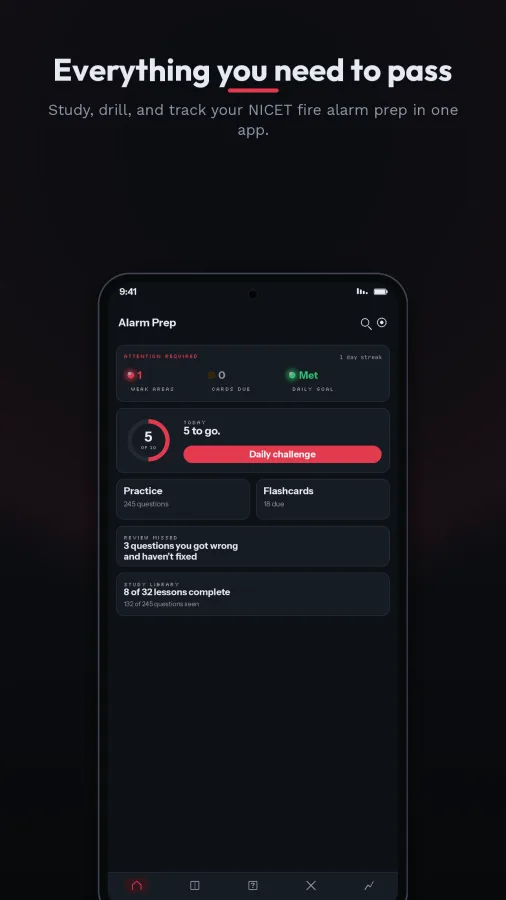

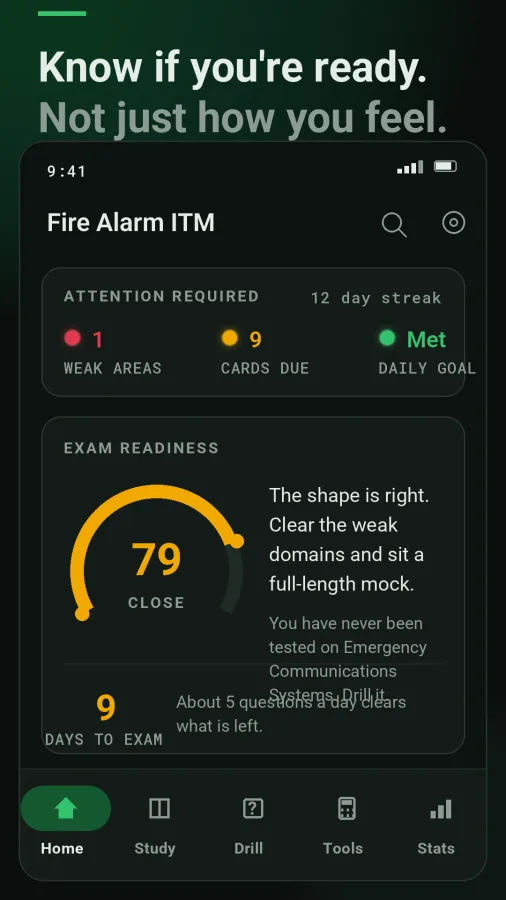
Fire Alarm ITM Prep: NICET
For: technicians who inspect and test fire alarm systems, going for ITFAS Level I or II.
- Full-length timed mocks at the real format: 85 questions in 110 minutes and 80 in 110
- A readiness score that weighs all twelve exam domains and your mock results, then names the next thing to fix
- 245 explained questions today, growing to 1,000 in the next major update; 32 lessons in 12 modules
- 127 spaced-repetition flashcards and an NFPA 72 field tool for the job after the exam
Free to study, with a one-time unlock for everything.

Fire Sprinkler Layout Prep - NICET
For: sprinkler designers and layout techs, including the two-sitting Level III.
- 1,000 questions across the twelve work elements, each tied to the NFPA 13 chapter it came from
- Mocks at the real sitting lengths, including Level III as two papers: General Plans and Hydraulics & Water Supply
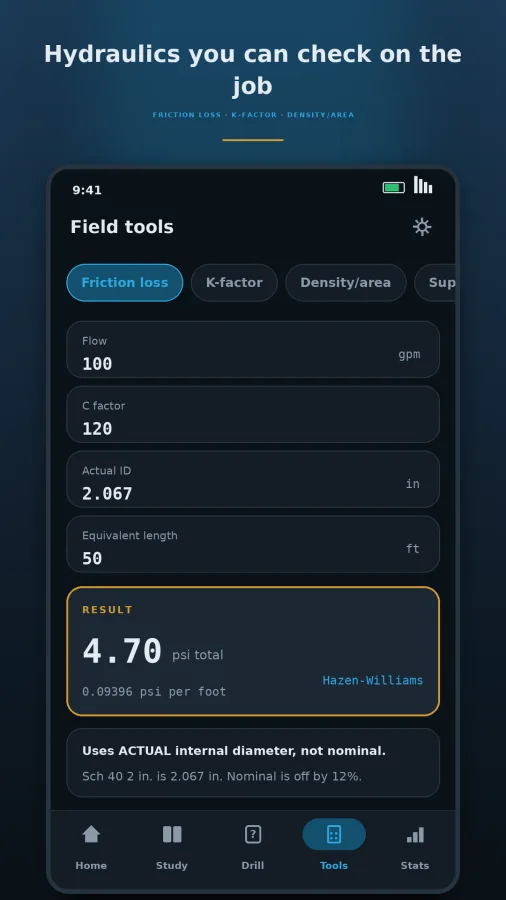
- Hydraulic calculators using actual internal pipe diameter: Hazen-Williams, K-factor, density/area, supply curves, hydrant tests
- 18 worked formulas, 25 plan symbols, a 155-term glossary and 127 review cards
Free to start; one purchase unlocks the full bank and tools.

Fire Sprinkler ITM Prep: NICET
For: sprinkler inspectors going for ITWBS, where the whole exam is finding the right NFPA 25 paragraph fast.
- 1,000 questions across all 12 NFPA 25 domains, each with an explanation and paragraph reference
- Mocks at real length (Level I 115 / 125 min, II 168 / 185, III 145 / 155) with an Open Book mode: search the schedule with the clock running
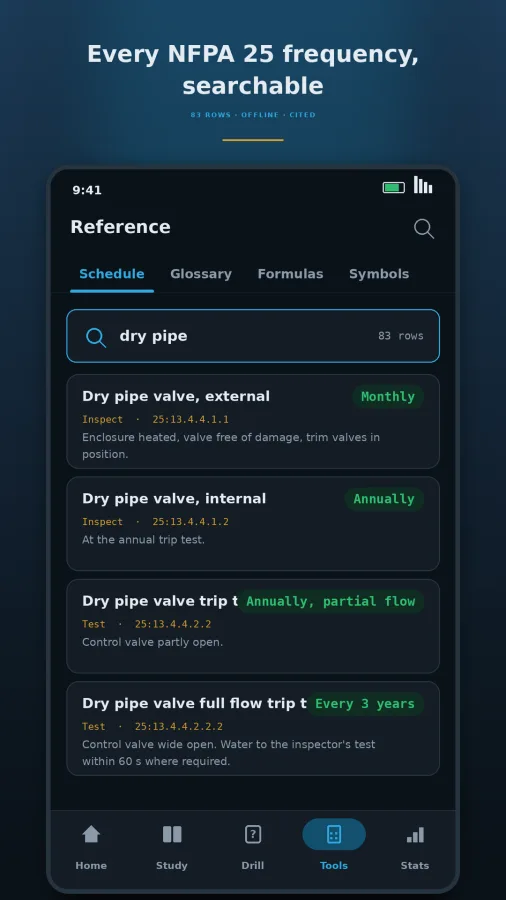
- The full NFPA 25 inspection, testing and maintenance schedule, searchable by component, activity and frequency
- Field calculators: main drain, fire pump, hydrostatic, K-factor, elevation, tank volume; a Listen mode for the drive
The whole reference library, including the inspection schedule, is free permanently. One purchase unlocks full access.

ERCES Prep: ERRCS BDA & DAS
For: BDA and DAS technicians and designers going for the IB-PSC (ERCES / ERRCS) certification.
- Timed simulations matched to the real formats: Level I 88 / 110 min, II 143 / 155, III 126 / 170, Design 110 / 150
- Exam-style questions across RF fundamentals, equipment, codes, survey and design, installation, testing, FCC rules and safety; 1,000 coming in the next major update
- Field reference: IFC 510 and NFPA 1225 coverage requirements, the DAQ scale, frequency bands, grid-test steps
- Offline RF tools: dBm to watts, VSWR, link budget, coax loss, cascade gains, isolation margin, 12-hour battery runtime, a 20-grid floor test tracker
Free to study, with a one-time unlock.


Fireforge: Fire Alarm Tools
For: the math you do on the job, not the exam: twelve calculators and references, offline.
- NAC voltage drop with instant pass/fail, NFPA 72 battery calculations, candela and strobe spacing, audibility
- Conduit bending that works the marks back from the obstacle and draws the pipe
- Voice/speaker circuits at 25 V and 70 V, resistor codes and EOL, Ohm's law, conduit fill
Free, no account.


Flowforge: Fire Sprinkler Kit
For: a fitter's daily hydraulics, spacing and testing math, with the reference tables, offline.
- K-factor flow, Hazen-Williams friction loss with real pipe IDs, flow test analysis, pitot flow, pipe volume
- Sprinkler, hanger and trapeze spacing, obstruction rules, deflector position
- Fire pump check, main drain, hydrostatic and standpipe demand, plus a searchable NFPA 25 ITM table
Free core tools; Pro unlocks the rest.

See the apps in action



From the blog
Longer reads on the exams and the field work behind them.
 NICET Prep Review: What Builds Exam ReadinessA practical NICET prep review: build a focused study plan, use timed practice, check code references, and prepare for the real exam without internet, too.
 How to Use a NICET Fire Alarm Practice TestUse a NICET fire alarm practice test to pinpoint weak topics, train under realistic time limits, and build a study routine for calmer exam-day decisions.
 ITM NICET Practice Questions That Build Exam SkillUse ITM NICET practice questions to find weak areas, build code-reference habits, and prepare for timed Fire Alarm Technician exams with less guesswork.
 Fire Sprinkler NICET Exam Questions That Build SkillFire sprinkler NICET exam questions work best when they test code use, hydraulics, inspection judgment, and pacing under realistic exam conditions on test day.
 NICET Water Based Layout Exam Study Plan That WorksPrepare for the NICET water based layout exam with a practical study plan for code navigation, drawings, hydraulics, and timed practice on a real schedule.
 How to Simulate Certification Testing WellLearn how to simulate certification testing with realistic timing, reference rules, scoring, and review habits that expose weak spots before exam day.
 8 Best Fire Inspection Study Tools for TechsFind the best fire inspection study tools for NFPA 25 work, from code references and timed practice exams to field-ready offline calculation aids for jobs.
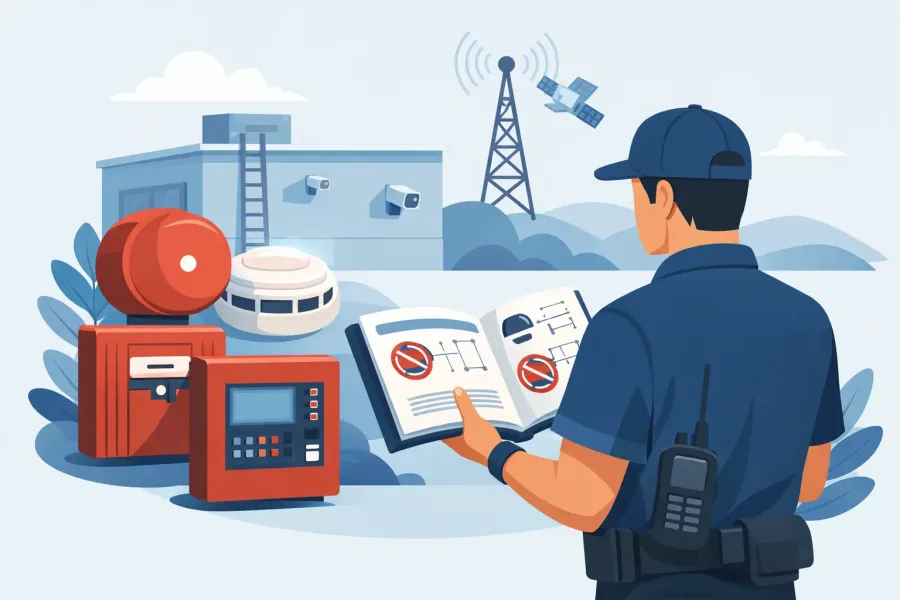 Offline NFPA 72 Code Reference for the FieldAn offline NFPA 72 code reference helps fire alarm professionals verify requirements in basements, job trailers, and dead zones without losing time on site.
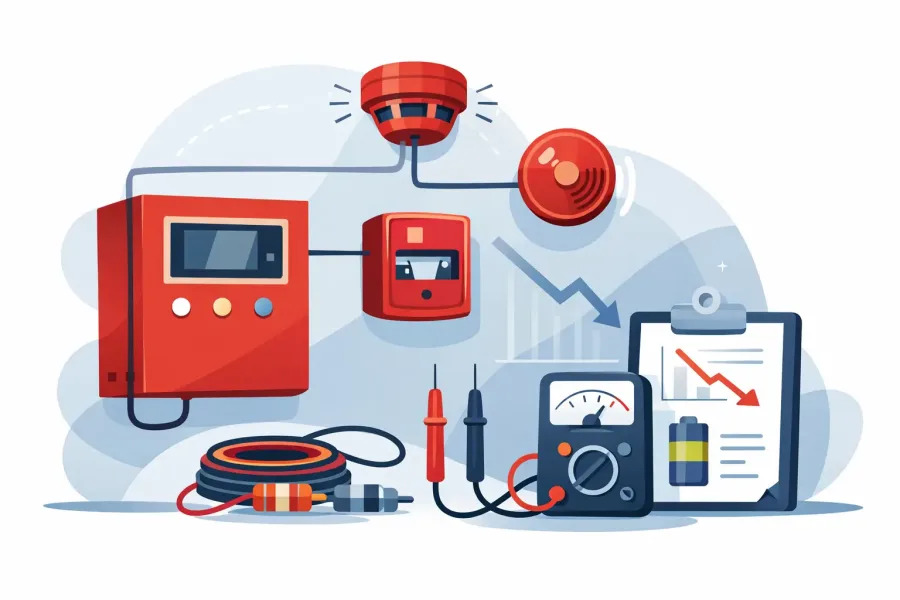 Fire Alarm Voltage Drop Calculator BasicsUse a fire alarm voltage drop calculator to check NAC and SLC circuits, select conductors, and verify devices receive usable voltage before installation.
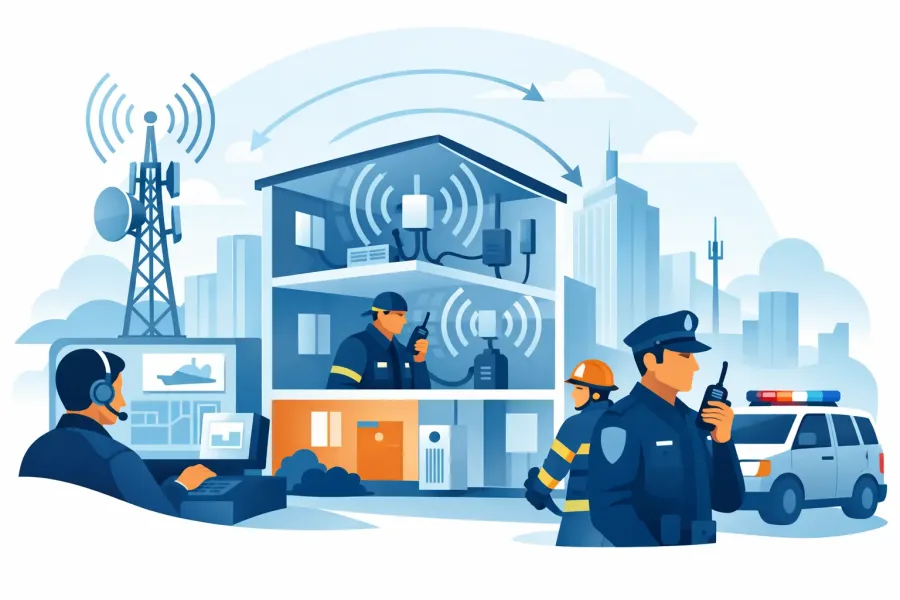 What Is an ERRCS System and Why It MattersWhat is an ERRCS system? Learn how in-building emergency radio coverage works, which parts it uses, and what contractors must test, document, and maintain.
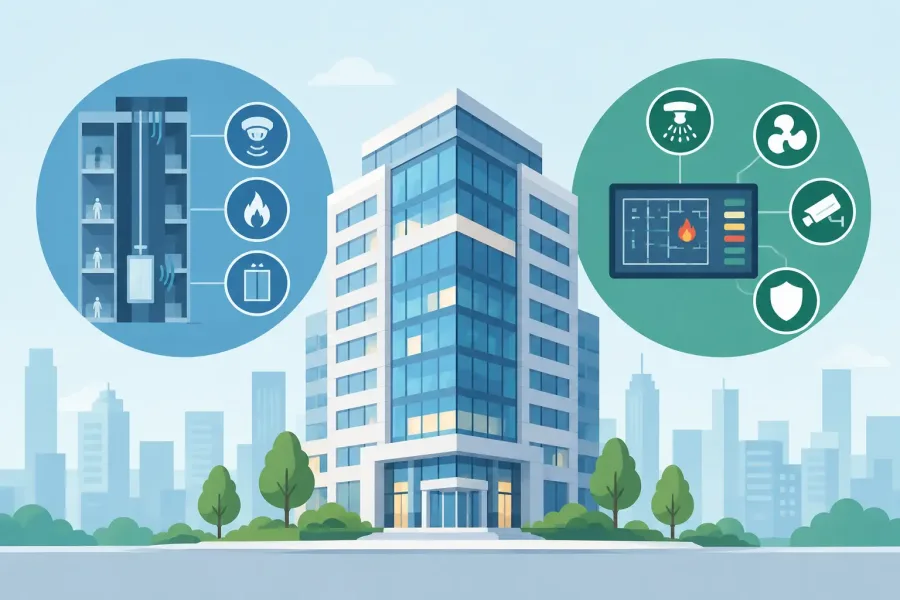 DAS Versus BDA Systems for Safer BuildingsCompare DAS versus BDA systems for in-building public-safety coverage. Learn where each fits, what codes require, and how to plan building upgrades well.
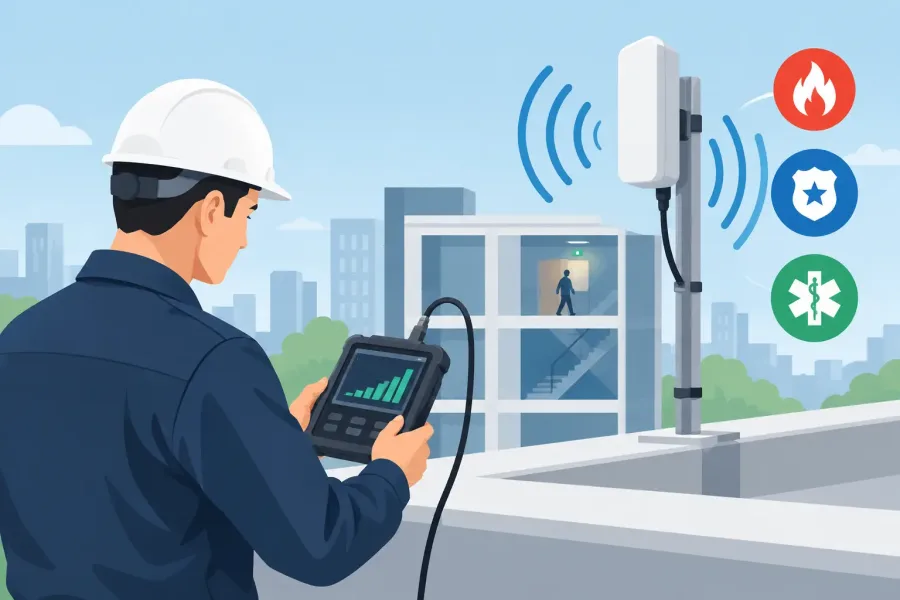 ERRCS Signal Testing Field Guide for TechniciansUse this ERRCS signal testing field guide to plan grid testing, document results, spot weak areas, and prepare for authority having jurisdiction review.
Quick answers
What is NICET certification?
NICET, the National Institute for Certification in Engineering Technologies, is a division of the National Society of Professional Engineers. It certifies engineering technicians by subfield and level (I through IV) based on a written exam, documented work experience and, at higher levels, recommendations. In fire protection its six programs cover fire alarm systems, fire alarm inspection and testing, water-based (sprinkler) layout, water-based inspection and testing, special hazards systems and in-building public safety communications.
Is NICET certification required to work on fire alarm or sprinkler systems?
It depends on where you work. Many states, cities and authorities having jurisdiction tie fire alarm and sprinkler licenses, plan submittals or inspection sign-offs to a NICET level, commonly Level II for installation technicians and Level III for designers. Many employers require it even where the law does not. Check your state fire marshal or licensing board for the exact rule.
Do I have to start at Level I?
No. You apply at the level your experience supports. Each level has its own exam, and a higher level requires you to document the performance measures of the levels below it as well as its own, so most technicians with two or more years of experience apply directly for Level II.
Is the NICET exam open book?
Effectively yes. For the fire alarm and water-based programs, NICET puts the referenced NFPA codes and standards on screen in a read-only format during the exam, and you may also bring physical copies. The exam tests whether you can find and apply the right requirement quickly, not whether you memorized it, so practice with the clock running.
How much does NICET certification cost?
For Fire Alarm Systems, the August 2026 candidate handbook lists application fees of $235 for Level I, $325 for Level II, $380 for Level III and $435 for Level IV. Recertification every three years is $215 for one subfield plus $55 for each additional subfield, with a $120 late fee to restore an expired certification. Other programs are priced similarly; confirm on nicet.org before you apply.
How long is a NICET certification valid?
Three years. To recertify you document 90 continuing professional development (CPD) points per certification, drawn from at least two categories, such as active practice (up to 72 points, 24 per year), additional education, advancing the profession or certification activity.
What happens if I fail the exam?
You can reschedule after 30 days, within the same six-month testing window, and you are limited to three attempts in any 12-month span. Use the content outline for your level to find the domains that need work before the retake.
Can I take the NICET exam online?
Exams are computer-based at Pearson VUE testing centers. For Fire Alarm Systems Level I, NICET also offers online proctoring through OnVUE; the other levels and programs are at a test center.
Which code editions are on the exam?
Each program and level lists specific editions, and the questions are written to those editions even if a newer one has been published. In 2026 the Fire Alarm Systems exams reference NFPA 72 (2022) and NFPA 70 (2020), with IBC (2021) from Level II and NFPA 101 (2021) at Level III; Water-Based Layout uses NFPA 13 (2022), 14 (2019), 20 (2022) and 291 (2022); Inspection and Testing of Water-Based Systems uses NFPA 25 (2023). Study the edition on the exam, not the newest one on the shelf.
How long should I study for a NICET exam?
Most technicians who pass on the first attempt put in six to ten weeks of short, regular sessions: learn the content outline and the layout of the references first, then practice by domain with explanations, then full-length timed mock exams at the real length. The pacing is the hard part, so time yourself from the start.
NICET is a registered certification mark of the National Institute for Certification in Engineering Technologies. NFPA and the NFPA standard numbers are trademarks of the National Fire Protection Association. TapForge Studios (99 Cent Apps LLC) is independent of both; this page and our apps are study aids, not official NICET materials, and are not endorsed by NICET or NFPA. Requirements, exam formats and fees change; the current candidate handbook at nicet.org is the authority. Corrections welcome at contact@tapforgeapps.com.