
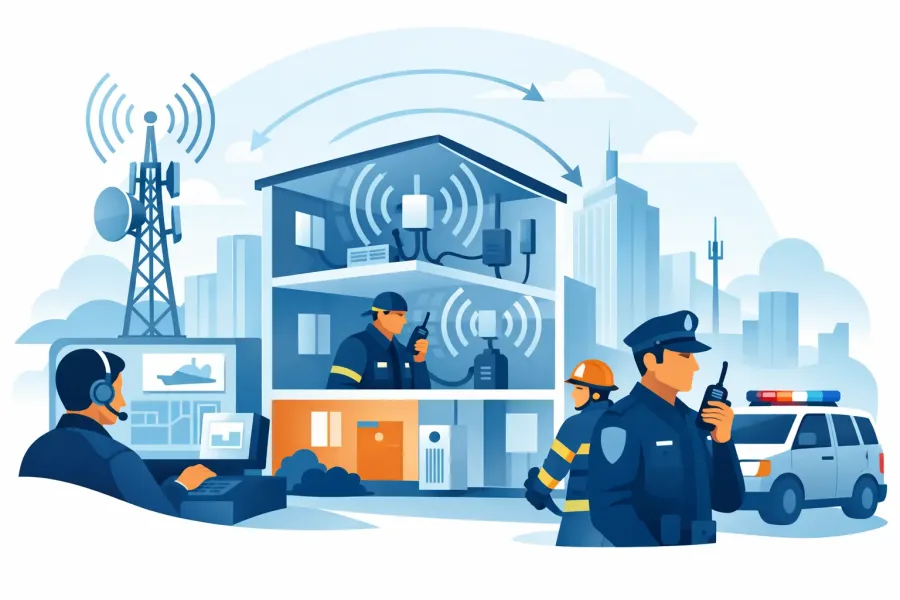
A firefighter enters a concrete stairwell, below-grade mechanical room, or high-rise floor and loses radio contact with command. That is the problem an ERRCS system is built to solve. So, what is an ERRCS system? It is an in-building emergency radio coverage system that brings usable public-safety radio signals into areas where a building blocks, weakens, or distorts them.
For fire alarm, low-voltage, electrical, and life-safety professionals, ERRCS is not just another signal system. It is a code-driven life-safety installation with its own survey requirements, equipment rules, acceptance testing, supervision, documentation, and maintenance expectations. The exact details depend on the adopted code edition, the jurisdiction, and the authority having jurisdiction, or AHJ.
What Is an ERRCS System?
ERRCS stands for Emergency Responder Radio Coverage System. You may also hear the term ERCES, meaning Emergency Responder Communication Enhancement System. In field conversations, plans, and product listings, the terms are often used interchangeably. The terminology can vary, but the job is the same: improve radio coverage for first responders inside a building.
A typical system captures an existing public-safety radio signal from outside the building, amplifies it through approved equipment, and distributes it indoors through antennas. In some applications, it may use a signal source provided by the public-safety radio network rather than relying only on an exterior donor signal.
The system is intended for approved public-safety frequencies, not ordinary cellular service. A building can have five bars of cell coverage and still fail emergency radio testing. Cellular DAS and ERRCS may use similar-looking pathways and antenna hardware, but they serve different users, frequencies, rules, and approving agencies.
Why Buildings Need Emergency Radio Coverage
Modern construction can be hard on RF signals. Reinforced concrete, low-emissivity glass, metal roofs, underground spaces, foil-backed insulation, elevator shafts, fire-rated assemblies, and dense building cores all create attenuation or signal dead zones. The bigger and more complex the building, the more likely coverage must be evaluated.
The need is not limited to towers and hospitals. Parking garages, schools, warehouses, multifamily buildings, hotels, tunnels, large retail spaces, and facilities with below-grade areas can all present radio-coverage problems. A building may look straightforward during rough-in, then fail testing after finishes, equipment, racks, and metal doors are in place.
That is why emergency radio coverage should be considered early. Waiting until final inspection can turn a coverage failure into an expensive scramble involving new cable paths, wall penetrations, rooftop work, or access above completed ceilings.
How an ERRCS System Works
Most ERRCS installations are based on a bidirectional amplifier, commonly called a BDA, and a distributed antenna system, or DAS. The BDA is the active equipment that receives and amplifies signals in both directions. The DAS is the network of cable, splitters, taps, and antennas that carries those signals through the building.
On the donor side, an exterior antenna receives the public-safety signal. The BDA processes and amplifies it. On the indoor side, the DAS distributes that signal to the areas where responders need it. Signals from portable radios travel back through the same system toward the outside radio network.
A basic system often includes these components:
- An approved BDA or signal amplifier matched to the required public-safety bands
- Exterior donor antenna equipment or an approved signal source
- Indoor antennas, coaxial cable, splitters, directional couplers, and related RF components
- A dedicated power source, backup batteries, and sometimes an emergency generator connection
- An annunciator panel or remote annunciator for status, faults, and supervision
- Monitoring connections and pathway protection required by the project specifications and applicable code
The design is not simply about getting signal everywhere. It must provide the required coverage level, reliability, pathway survivability, system supervision, and access for inspection. A system that looks clean on a floor plan can still perform poorly if antenna placement, cable loss, donor signal quality, or building materials were misjudged.
The BDA Is Not a Generic Signal Booster
This distinction matters. Public-safety BDAs must be properly selected, installed, coordinated, and approved. An improperly configured amplifier can create interference with the radio system it is supposed to support. The frequencies, channel bandwidth, gain settings, filters, donor signal conditions, and radio-system authorization all matter.
Do not assume a device marketed as a signal booster is suitable for ERRCS work. The installation has to meet the requirements of the project, the AHJ, and the public-safety radio system owner. In many jurisdictions, coordination with the local radio authority is part of the process before a system is activated.
ERRCS Code Requirements Depend on the Jurisdiction
ERRCS requirements are commonly tied to building and fire code provisions, with installation, monitoring, and inspection requirements shaped by standards such as NFPA 72 and NFPA 1225, along with adopted I-Codes and local amendments. But no technician should treat a general code reference as a permit-ready design.
The adopted edition matters. One city may be operating under a different code cycle than the neighboring city. One AHJ may require coverage testing before deciding whether an ERRCS is needed, while another may have specific occupancy triggers, preapproved equipment rules, or radio-shop coordination requirements.
The safest working approach is direct: verify the current local requirements before design, confirm the approved radio bands and test method, and document decisions early. That is more useful than relying on a design from another state or a code summary from several years ago.
Common Requirements to Plan For
Although details vary, most projects involve some combination of initial radio survey work, floor-by-floor coverage testing, critical-area testing, system battery calculations, pathway survivability, fire alarm interface or monitoring, annunciation, labeling, and periodic retesting.
The acceptance test is often the moment that exposes weak assumptions. Testing may evaluate delivered audio quality, signal strength, reliability, uplink performance, downlink performance, and coverage across a defined grid or designated critical areas. A passing test in an open corridor does not automatically prove coverage in stairwells, elevators, electrical rooms, fire command centers, or underground levels.
Design and Installation Challenges in the Field
ERRCS work crosses several disciplines. The installer may need to understand RF coverage, listed equipment, fire alarm interfaces, power supplies, backup power, cable routing, construction coordination, and documentation. The radio consultant, electrical contractor, fire alarm contractor, low-voltage contractor, general contractor, and AHJ may all have a role.
The hardest problems are often practical rather than theoretical. A donor antenna location may have a poor signal path or conflict with roof access rules. A required riser pathway may be difficult to protect after the building is finished. An antenna location shown on a drawing may land beside ductwork, steel, or a beam. A battery cabinet may be placed where service access is poor.
Good installers leave room for testing and adjustment. Antenna layouts can require changes after the system is energized and measured. Cable lengths, split ratios, and antenna gain all affect the final result. Treating the drawing as the final RF answer is a mistake.
Testing, Records, and Ongoing Maintenance
An ERRCS system is not a set-it-and-forget-it installation. Battery capacity changes with age. Construction changes can alter RF conditions. A tenant build-out can add walls, metal shelving, or equipment that affects coverage. A fault condition may go unnoticed if monitoring is not functioning correctly.
Commissioning records should clearly show what was installed, how it was tested, which frequencies and radio channels were evaluated, the test locations, the results, and the parties involved. Keep equipment manuals, battery information, as-built drawings, antenna maps, and approval records organized. When a system is inspected years later, these records can save hours of guesswork.
Maintenance also needs to follow the adopted standard, manufacturer instructions, and AHJ direction. That may include periodic functional inspection, battery checks, alarm and supervisory signal verification, and coverage retesting. The required interval is not something to assume from a different jurisdiction or a different code edition.
Practical Takeaway for Technicians and Contractors
ERRCS sits at the intersection of life safety and radio engineering. That makes disciplined preparation valuable. Before quoting or installing, confirm whether the building actually requires enhanced coverage, what the AHJ accepts, what public-safety frequencies apply, who controls radio-system authorization, and who owns final testing responsibility.
For apprentices and technicians studying life-safety systems, learn the vocabulary first: BDA, DAS, donor antenna, uplink, downlink, annunciator, survivability, supervision, and coverage grid. Then connect the terms to the field sequence: survey, design, install, test, document, maintain. That sequence makes ERRCS easier to understand than memorizing acronyms alone.
The real standard for a good ERRCS installation is simple: when responders move into the parts of a building where radio coverage is hardest to maintain, their communication still works. Build, test, and document the system with that moment in mind.