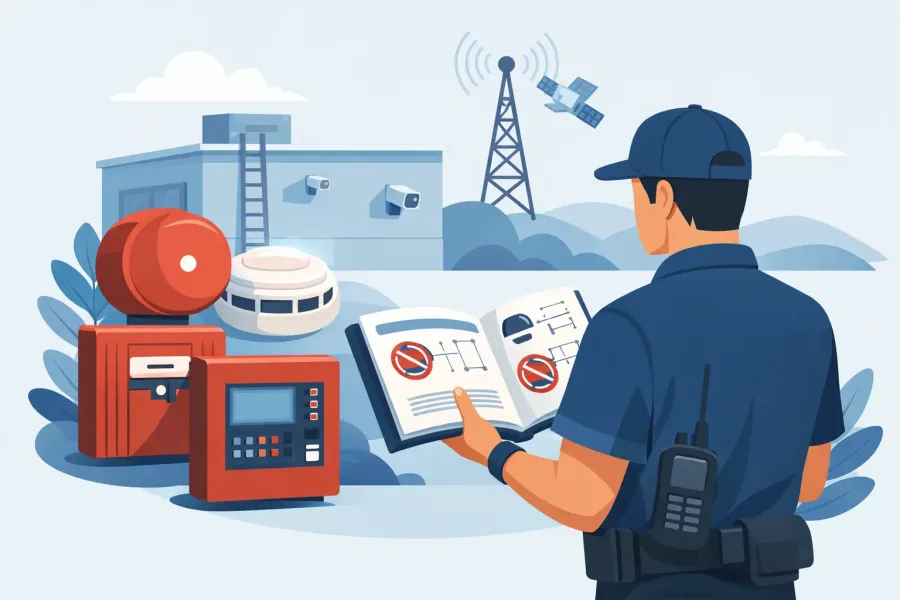
A signal issue in a concrete basement is a bad time to find out your code reference needs a login. An offline NFPA 72 code reference gives fire alarm technicians, inspectors, designers, and apprentices a practical way to check requirements when cellular service is weak, Wi-Fi is unavailable, or a jobsite network is not yours to use.
For field work, offline access is not a convenience feature. It is the difference between verifying a detail at the panel and writing down a question to chase later. The best setup puts the information you use most within a few taps, while keeping the limits of a mobile reference clear.
Why an offline NFPA 72 code reference matters
Fire alarm work rarely happens at a desk with a stable connection. It happens above ceilings, inside electrical rooms, on new construction sites, in hospitals with restricted networks, and in older buildings where service drops as soon as you pass the lobby. A reference that depends on the cloud may be useful in the office, but it can fail at the exact moment you need it.
Offline access lets you search and review material without waiting for pages to load. That matters when you are tracing a notification appliance circuit, checking a testing question before an inspection, reviewing basic pathway requirements, or studying during a lunch break in the truck.
It also supports better work habits. When the reference is immediately available, it is easier to stop and confirm a detail instead of relying on a half-remembered rule. That does not replace experience. It gives experience a reliable backstop.
What a field-ready reference should do
A useful mobile code reference is not simply a scanned book squeezed onto a phone screen. Fire alarm professionals need information organized around real questions, with search that works without a connection and navigation that does not waste time.
Search should handle the way technicians think
On a jobsite, people often search by a term, a component, or a problem rather than by a chapter number. You may remember “smoke detector spacing,” “duct detector,” “visible notification,” “battery,” or “inspection records” before you remember the exact section. A good offline reference makes those paths useful.
Search is most helpful when results are clear enough to narrow the question quickly. It should not force you through a browser-style maze or return a pile of loosely related results. Bookmarking frequently used topics can save even more time for recurring service and inspection work.
The content must fit the work
NFPA 72 covers a wide range of fire alarm and signaling topics, including initiation, notification, pathways, emergency communications, inspection, testing, and documentation. A field tool does not need to turn every task into a study session. It should help the user get oriented, locate relevant material, and move to the next step with confidence.
That means the app or reference should be readable on a phone, usable one-handed when necessary, and built for quick return visits. Dense source material is part of the trade. Bad navigation does not have to be.
Offline means truly offline
Some products call themselves offline because they cache a few screens after you open them. That is not the same as having content stored on the device. Before relying on any app in the field, test it in airplane mode.
Open the sections you expect to use. Run a few searches. Check whether saved notes and bookmarks remain available. If the tool stalls, requests a sign-in, or displays blank results without a connection, it is not a dependable offline field reference.
Code reference is not code authority
This distinction matters. NFPA 72 is a consensus standard, but the applicable requirements for a project depend on the edition adopted by the jurisdiction, amendments, contract documents, the building code, the fire code, manufacturer instructions, and the authority having jurisdiction.
A fast reference can help you identify the right question and find the relevant provision. It cannot tell you which edition your local jurisdiction has adopted, whether an amendment changes the result, or how the AHJ will interpret a site-specific condition. Those answers require project records and, when needed, direct confirmation.
There is also a difference between an educational reference and an official code publication. NFPA standards are copyrighted. A legitimate app should clearly explain what it contains and should not imply that a condensed guide, study material, or searchable reference is a substitute for the official adopted code text.
The practical rule is simple: use an offline tool to work faster and study smarter, then verify the controlling edition and local requirements before making a final design, installation, or inspection decision.
Choosing the right edition matters more than most people think
A reference can be accurate and still be wrong for the job if it is based on a different edition than the one adopted locally. Requirements and terminology can change between editions. A technician preparing for a NICET exam may also need to study from the edition specified by that exam program, which may not match the edition used on a current project.
Before you depend on an app, confirm three things: the edition covered, the date of its content update, and whether it identifies its source material clearly. If an app is vague about its edition, treat it as general study help rather than jobsite authority.
This is especially relevant for contractors working across city or state lines. One crew may service multiple jurisdictions in a month. Keeping the project-specific adopted code information in the job file prevents an otherwise useful reference from becoming a source of avoidable rework.
How to use an offline reference without slowing down
The most effective approach is to set up the tool before the service call or inspection. Download any needed content while you have a connection, update the app, and add bookmarks for subjects you encounter often. For a fire alarm technician, that might include detection, notification, batteries, inspection and testing, documentation, and supervising station basics.
During field work, start with the actual condition. Identify the device, system type, occupancy issue, or documentation question. Then use the reference to narrow the requirement. Do not search for a conclusion you already want. Search for the topic, read the surrounding material, and check for exceptions, tables, notes, and cross-references that affect the answer.
For complex conditions, take a clear note of the section or topic and bring the question back to the project manager, designer, or AHJ. This is not hesitation. It is good trade practice. An offline reference is valuable because it keeps the investigation moving even when the signal bars disappear.
A practical tool for study and field confidence
Offline references also earn their place outside the jobsite. Apprentices can review terminology between classes. NICET candidates can reinforce code-related concepts without being distracted by ads, browser tabs, or an unreliable connection. Experienced technicians can refresh a subject before walking into a facility they have not serviced before.
That is the thinking behind offline-first trade tools from TapForge Studios: keep useful material on the device, make it quick to find, and avoid turning a straightforward reference task into a connectivity problem. The goal is not to replace professional judgment. It is to support it where the work actually happens.
A phone will not replace the adopted code, the plans, or a conversation with the AHJ. But when you are standing in a mechanical room with no service and a real question in front of you, an offline NFPA 72 code reference can be the tool that keeps the next decision grounded, documented, and moving forward.