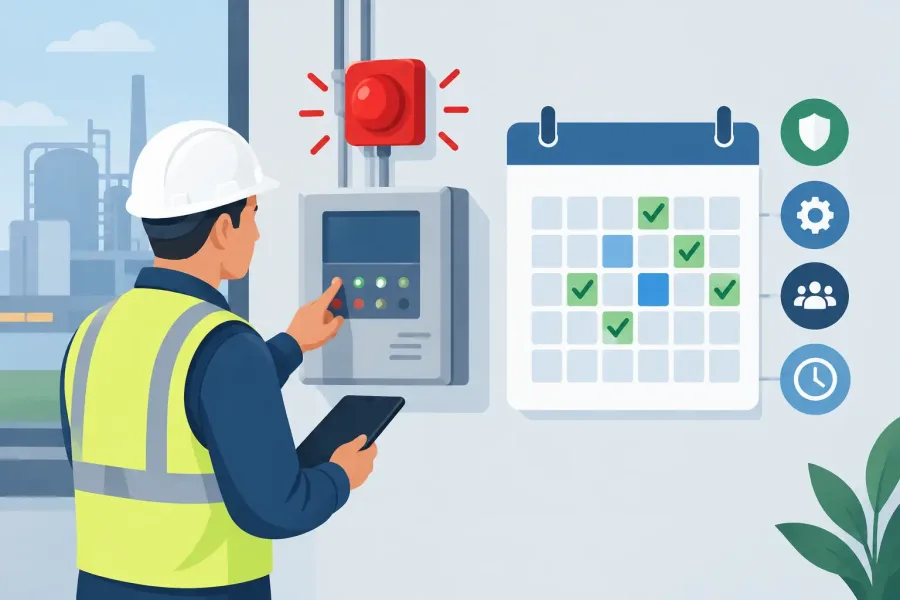
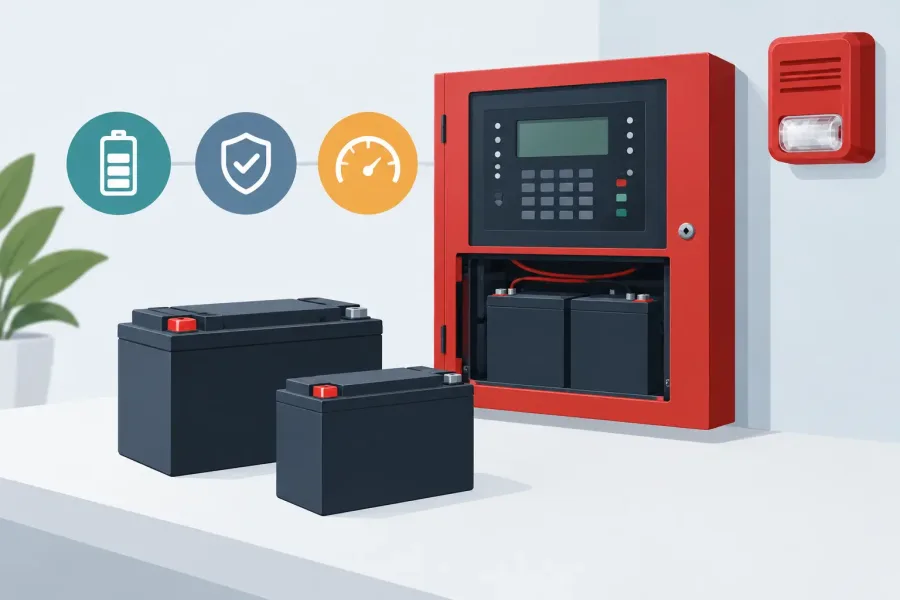
A fire alarm panel can look normal right up until utility power drops. That is when battery capacity stops being a line item on a submittal and becomes the system’s only source of standby and alarm power. To size alarm batteries correctly, you need the actual connected load, the required standby and alarm duration, and the panel manufacturer’s charging and battery limits.
For technicians, designers, and NICET candidates, the basic math is straightforward. The field conditions around that math are where costly mistakes happen: missed modules, powered devices on a remote power supply, undersized enclosure space, or a battery charger that cannot support the selected capacity.
What Fire Alarm Battery Sizing Is Really Measuring
Battery sizing answers one practical question: can the secondary power supply keep the complete system operating for the required time after normal AC power is lost?
That includes two different operating states. During standby, the panel and connected equipment are powered but not actively in alarm. During alarm, notification appliances, releasing circuits, amplifiers, door holders, communicators, and other active loads may draw substantially more current.
The calculation combines both energy demands:
Required amp-hours = standby current × standby time + alarm current × alarm time
Use current in amps and time in hours. If a current value is listed in milliamps, divide it by 1,000 before calculating. A 250 mA load is 0.250 A, not 250 A.
The required duration is not something to guess. NFPA 72, the adopted code edition, the system type, and the authority having jurisdiction can all affect the required standby and alarm periods. Many standard protected-premises fire alarm systems use 24 hours of standby followed by 5 minutes of alarm operation. Voice evacuation and other system arrangements can require different durations. Always start with the project requirements and the applicable manufacturer documentation.
How to Size Alarm Batteries Step by Step
Start with the manufacturer’s load data
The panel installation manual is the starting point, not a generic battery chart. It should identify the panel’s standby current, alarm current, charger capacity, maximum battery size, and approved battery types.
Then add every device and accessory powered by that panel or power supply. That may include addressable modules, smoke detectors, pull stations with LEDs, remote annunciators, cellular or IP communicators, door holders, auxiliary relays, NAC boosters, and remote power supplies. A separate power supply needs its own calculation unless the manufacturer specifically directs otherwise.
For notification appliance circuits, use the listed alarm current for the exact appliance, candela setting, tone, and voltage. A horn-strobe set to 15 cd does not necessarily draw the same current as that same device set to 75 cd. Strobes often drive the alarm calculation, especially on larger systems.
Calculate standby amp-hours
Add the standby current for all equipment on the power source. Multiply that total by the required standby period.
Suppose a conventional 24 V panel and its connected devices draw 0.180 A in standby. For 24 hours:
0.180 A × 24 hours = 4.32 Ah
That is the capacity consumed before the alarm event even begins. A system with low alarm current can still need sizable batteries if its standby load is high.
Calculate alarm amp-hours
Next, total the current when the system is in alarm. Include the panel’s alarm current plus all loads that operate during the required alarm period.
If the same system draws 1.60 A in alarm and requires 5 minutes of alarm operation, convert five minutes to hours:
5 minutes ÷ 60 = 0.083 hours
Then calculate:
1.60 A × 0.083 hours = 0.13 Ah
Add the two values:
4.32 Ah + 0.13 Ah = 4.45 Ah
That number is the raw capacity requirement before any required safety factor or manufacturer-specific adjustment.
Apply the required margin and select the battery set
Battery capacity decreases with age, temperature, discharge rate, and real installation conditions. Code requirements, manufacturer worksheets, and project specifications commonly require a margin above the calculated minimum. A frequently used approach is multiplying the calculated capacity by 1.2, but do not apply a blanket factor when the panel manual or governing requirements specify another method.
Using a 20 percent margin in this example:
4.45 Ah × 1.20 = 5.34 Ah
A pair of 12 V, 7 Ah sealed lead-acid batteries wired in series would provide a 24 V, 7 Ah battery set. That meets the calculated capacity in this example, assuming the panel permits 7 Ah batteries and the charger can properly maintain them.
Series wiring increases voltage, not amp-hour capacity. Two 12 V, 7 Ah batteries in series provide 24 V at 7 Ah. If greater capacity is needed, matched series strings may be connected in parallel when the equipment manufacturer permits it. That arrangement needs careful attention to wiring, fusing, charging capacity, enclosure space, and battery matching.
Common Battery Sizing Mistakes on Real Jobs
The cleanest worksheet can still be wrong if its loads are incomplete. The most common miss is counting the fire alarm control unit but overlooking equipment outside the main cabinet. Remote power supplies, NAC extenders, voice evacuation panels, distributed amplifiers, and releasing panels often have their own battery requirements.
Another problem is using a device’s standby current where its alarm current belongs. This is especially easy to do with notification appliances and addressable devices that change state in alarm. Read the manufacturer data for the installed configuration, not just the product family.
Battery ratings also need context. A battery labeled 7 Ah is rated under a defined test condition, often over a 20-hour discharge rate. A higher discharge load, cold location, aging battery, or weak charger can reduce usable performance. That is why the calculation margin and listed equipment compatibility matter.
Do not assume a bigger battery is automatically better. The panel charger has a limited output and may have a maximum supported battery capacity. Oversizing can create charging problems, violate listing instructions, or place batteries in an enclosure that cannot safely contain them. The right answer is the smallest listed battery set that meets the calculated requirement with the required margin, unless project requirements call for additional capacity.
Battery Selection Is More Than Amp-Hours
Most fire alarm systems use sealed lead-acid batteries because they are common, rechargeable, and designed for standby service. They are not interchangeable with every 12 V battery sold for consumer use. Use batteries that meet the equipment and system requirements, are appropriately rated for standby service, and fit the cabinet or listed battery enclosure.
Verify voltage, amp-hour rating, terminal style, physical dimensions, date code, and replacement compatibility. When replacing a series pair, replace both batteries together with matching type, capacity, and age. Mixing an old 7 Ah battery with a new one can leave the entire string limited by the weaker unit.
Field maintenance matters after the calculation is complete. Inspect terminals for corrosion, verify connections are tight, check charger voltage according to the equipment instructions, and record battery replacement dates. A passed battery calculation does not prove a neglected battery set will perform years later.
A Better Workflow for Design, Service, and Exam Prep
Build the calculation from the power source outward. Start with the panel, then each connected circuit, then every remote accessory. Separate standby and alarm columns from the beginning. That avoids trying to reconstruct the calculation after a device has been missed.
For NICET preparation, practice converting minutes to decimal hours and recognizing the difference between voltage, current, and capacity. Voltage tells you system compatibility. Current describes the load. Amp-hours describe stored capacity over time. Confusing any two of those can produce an answer that looks reasonable but fails in the field.
For service work, compare the installed batteries against the latest calculation and the panel documentation before ordering replacements. If the system has added devices, changed strobe settings, or received a communicator upgrade, the old battery size may no longer be adequate.
TapForge Studios builds offline-first trade tools around this kind of practical detail: the information you need should still be available in a basement, mechanical room, or jobsite with poor signal.
A battery calculation is small enough to fit on a worksheet, but it protects the one period when a life-safety system cannot depend on normal power. Take the extra minute to account for every load, use the right duration, and verify the selected batteries are actually supported by the equipment.