
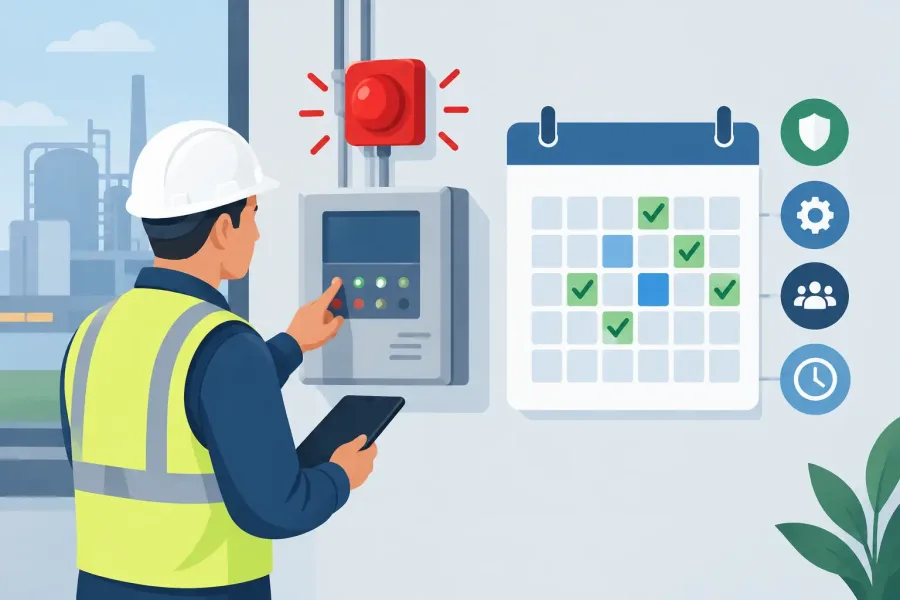
A missed alarm test is rarely caused by a technician who does not know how to test. More often, the schedule was vague, a device list was incomplete, access was not arranged, or the team treated annual testing as the whole plan. Good alarm testing schedules turn a large, interruption-heavy job into repeatable work that protects occupants, keeps records defensible, and gives technicians a clear starting point.
For fire alarm work, the schedule must do more than put dates on a calendar. It has to account for the system installed, the building’s use, the applicable code edition, the authority having jurisdiction, manufacturer instructions, monitoring requirements, and the practical reality of getting into every required space. A hospital, school, warehouse, and small office may all have fire alarm systems, but they do not present the same testing challenge.
Start With the System, Not the Calendar
The fastest way to build a weak schedule is to begin with a generic reminder that says “annual fire alarm inspection.” Annual work matters, but it is only one layer. Start by identifying what is actually connected to the system and what function each component serves.
Document the control unit, annunciators, power supplies, communicator, batteries, initiating devices, notification appliances, supervisory devices, interfaces, and emergency control functions. Include equipment that gets overlooked because it is not obviously part of the fire alarm panel, such as duct detectors, elevator recall interfaces, door holders, smoke control connections, sprinkler supervisory switches, and off-site transmission equipment.
This inventory gives the schedule a backbone. It also exposes gaps before the test date. If nobody can say where the remote power supply is, whether the panel is reporting to the correct supervising station, or which devices serve a tenant build-out, the schedule is not ready.
A useful working record identifies each item by location, device type, circuit or address, normal condition, required test interval, and last completed test. The goal is not paperwork for its own sake. The goal is to let a technician walk into the building and know what must be verified.
Build Alarm Testing Schedules Around Required Frequencies
NFPA 72, adopted local requirements, manufacturer instructions, and the AHJ establish the actual testing and inspection obligations. Those requirements can vary by code edition and jurisdiction, so do not copy intervals from an old report and assume they still apply. Confirm the governing requirements for the property before setting the recurring plan.
In practice, most schedules work best when they separate work into several time horizons instead of treating everything as one annual event. A control unit may need routine visual attention. Batteries need checks appropriate to the equipment and maintenance plan. Certain functions require periodic testing, while a broader annual test verifies system operation and documentation.
For many properties, organize the plan around these four buckets:
- Routine site checks for visible trouble conditions, panel status, impaired features, and obvious physical damage.
- Periodic inspection and maintenance tasks for power supplies, batteries, transmitters, and other equipment with recurring service needs.
- Annual functional testing of required initiating, notification, supervisory, and control functions.
- Event-driven testing after repairs, programming changes, renovations, device replacements, impairments, or system modifications.
The exact interval belongs in the applicable standard, adopted local rules, and equipment documentation. The schedule should reference those sources, not replace them. When requirements conflict or a condition is unusual, get direction from the AHJ or the responsible design professional rather than making a convenient assumption.
Do Not Forget Event-Driven Testing
Calendar-based testing is only half the job. A fire alarm system can change on a Tuesday and be due for its next annual test months later. That does not make the change low risk.
Any work that affects programming, wiring, device addressing, notification circuits, communicator settings, control relays, or interface logic should trigger a defined retest process. The scope depends on what changed. Replacing one smoke detector may call for a focused verification, while modifying a sequence involving elevator recall, smoke control, or releasing equipment can require broader functional testing and coordination.
Write that trigger into the schedule. “Test after modification” is too vague. State who decides the retest scope, who must be notified, and where the results are recorded.
Plan the Test Like a Job, Not an Appointment
A date on a work order does not guarantee a successful test. Before dispatching, confirm building hours, contacts, access restrictions, tenant spaces, high-noise areas, controlled rooms, and any operational windows. A device located over a production line or inside a secured medical area cannot be treated like a detector in an empty hallway.
Coordinate impairments in advance. The building owner or representative needs to understand what will be disabled, how long it may be unavailable, what temporary precautions are required, and who will restore the system. If the system reports off-site, notification and restoration procedures must be clear. A test signal that was never placed on test can create unnecessary dispatches. A panel left in test mode creates a much worse problem.
Technicians also need the right information before they arrive: current drawings where available, prior inspection reports, device lists, panel history, spare parts status, passwords and authorization procedures, and known deficiencies. Offline access matters here. Mechanical rooms, basements, stair towers, and construction sites are not reliable places to depend on a signal or a cloud login.
Make the Record Useful Six Months Later
A completed report should tell the next technician what happened without requiring a phone call to the last one. Record pass or fail status, device location, tested function, readings where required, deficiencies, corrective action, and the person completing the work. Include notes that explain conditions, not just shorthand like “bad” or “fixed.”
For example, “third-floor north stair horn strobe did not operate during NAC test; circuit restored after replacing damaged connection above ceiling” gives a future technician context. “Repaired NAC” does not.
Clear records also help identify patterns. Repeated battery trouble, recurring ground faults, intermittent communication issues, or devices damaged in the same loading area are not isolated events when they keep appearing in reports. They are maintenance planning signals.
Use Deficiency Priorities Carefully
Not every issue has the same urgency. A missing detector cover, a failed notification appliance, a disabled supervisory point, and a mislabeled device can all require correction, but their impact and response path may differ. Your process should define how deficiencies are escalated, communicated, tracked, and closed.
Avoid the common trap of treating the inspection report as the end of the job. A deficiency list with no owner, no due date, and no follow-up is just a better-formatted delay. Make sure the responsible party knows what was found, what the operational impact is, and what action is needed.
Adjust the Schedule When the Building Changes
Buildings change faster than many fire alarm records do. A warehouse adds racks. An office becomes a daycare. A tenant remodels behind locked doors. A new cellular communicator replaces an older transmission path. Each change can affect access, device visibility, notification coverage, system programming, or test scope.
Review alarm testing schedules after renovations, occupancy changes, recurring deficiencies, false alarm patterns, and significant equipment replacements. This does not always mean increasing the frequency of every task. Sometimes the better answer is a better device map, a different access plan, improved labeling, or a focused maintenance visit before the annual test.
For technicians preparing for NICET or building confidence in field work, this is the practical lesson: code knowledge and test execution belong together. Knowing a requirement matters. Being able to plan access, verify a sequence, document results, restore the system, and communicate a deficiency is what makes the work dependable.
A Schedule Should Make the Next Right Step Obvious
The best schedule is not the longest spreadsheet or the prettiest calendar. It is the one that tells the team what must be tested, when it is due, what has changed, who needs notice, and what to do when something fails.
Keep it current, keep it specific to the property, and make it available where the work happens. A well-built schedule gives technicians less guesswork, building owners fewer surprises, and life-safety systems a better chance of doing their job when the building needs them most.