
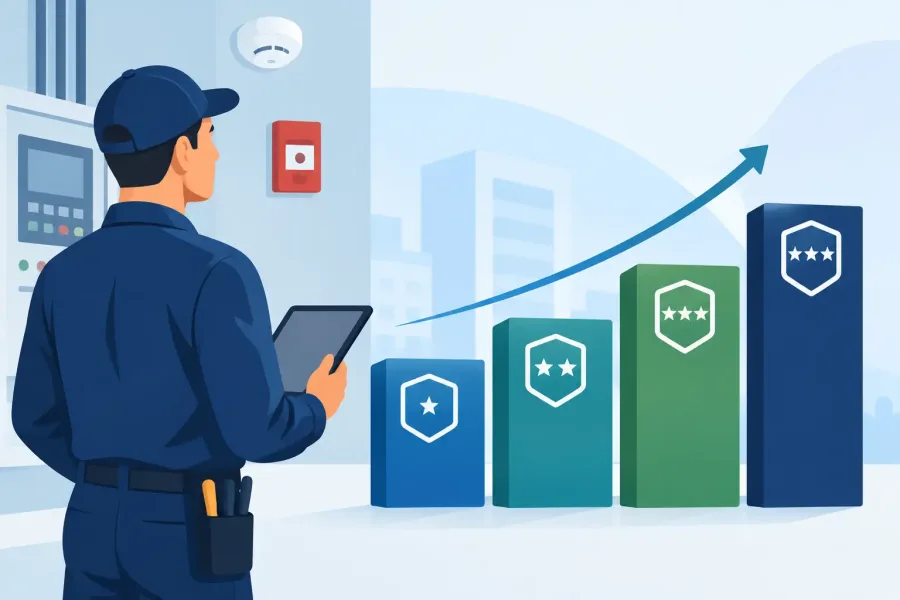
A NICET credential can change how an employer, contractor, or AHJ sees your qualifications. But the letters and level numbers only help if you understand what they represent. The practical truth behind NICET level differences is that each step asks you to prove more than recall. As levels rise, the work moves from following established procedures toward evaluating systems, solving unusual problems, documenting decisions, and taking responsibility for results.
That makes the right question less about which level is “best” and more about which level matches the work you actually do now and the work you want to do next.
What NICET Levels Are Designed to Show
NICET certifications are built around job performance, not just passing a test. A credential is meant to show that you have relevant field experience and can apply technical knowledge within a defined discipline. Depending on the program, that may involve fire alarm systems, water-based fire protection, inspection and testing, electrical work, or public-safety communications.
The exact requirements vary by certification program and can change when NICET updates its criteria. Always use the current program details, exam content outline, and candidate requirements for the credential you are pursuing. Do not assume that a level name in one field carries the same scope, exam format, or experience requirement in another.
Still, the broad progression is useful. Early levels generally focus on performing defined tasks correctly. Mid-level credentials call for stronger troubleshooting and independent judgment. Advanced levels are associated with broader technical responsibility, coordination, review, and decision-making.
NICET certification is also not automatically the same thing as a state license, a manufacturer certification, or an employer qualification. A license may be legally required for certain work. A NICET credential may be requested by a specification, municipality, contractor, or customer. In many careers, they work alongside each other rather than replacing one another.
NICET Level Differences in Day-to-Day Work
Entry-level: learning the system and the standard
At the entry level, the emphasis is usually on fundamentals. You need to understand the vocabulary, equipment, basic code concepts, safety expectations, documentation, and common field procedures tied to your discipline.
For a fire alarm technician, that can mean identifying initiating devices and notification appliances, understanding circuit basics, recognizing common NFPA 72 terminology, and following test procedures. For a sprinkler inspection professional, it may mean understanding inspection points, impairment procedures, basic component identification, and the records that support NFPA 25 work.
This level fits apprentices, newer technicians, and workers who have hands-on exposure but are still building a complete picture of the system. It does not mean the work is easy. It means the technician is expected to perform assigned tasks using established methods and supervision where needed.
Intermediate-level: applying knowledge without a script
The next step is where many technicians notice the real jump. You are no longer studying only what a device is or what a rule says. You are expected to apply requirements to conditions that are not identical to the training example.
An intermediate technician may need to trace a fault, interpret plans, assess whether a deficiency affects system performance, select an appropriate test method, or recognize when a condition requires escalation. The job still has procedures, but you must understand why the procedure exists and what to do when the normal path does not solve the problem.
This is often the level that supports a move from helper or installer toward lead technician, service technician, inspector, or a role with more independent customer and project responsibility. Field experience matters here because exam questions can test judgment that is hard to gain from flash cards alone.
Advanced-level: evaluating, coordinating, and owning decisions
Higher-level NICET credentials, including advanced levels in programs that offer them, are built around broader responsibility. The work may involve reviewing plans, coordinating with other trades, evaluating technical options, resolving unusual issues, supervising technical work, or supporting compliance decisions.
At this stage, the technician or specialist is expected to connect multiple pieces of a system. A change in one area can affect power, survivability, coverage, testing, documentation, inspection acceptance, or maintenance planning somewhere else. That wider view is what separates advanced responsibility from simply having more years in the trade.
Not every technician needs an advanced level to do good work. A skilled service tech may have a rewarding career at an intermediate level, while a designer, inspector, project lead, or authority-facing specialist may have a stronger reason to continue. The right path depends on your role, local market, company structure, and the types of projects you want to handle.
Experience Requirements Matter as Much as Exam Prep
A common mistake is treating NICET like a school test with a single finish line. Studying is necessary, but it is only one part of the qualification process. Experience records, work history, performance verification, and program-specific requirements can be just as important.
Start tracking your work before you are ready to apply. Keep a straightforward record of projects, dates, duties, systems worked on, and the kind of responsibility you held. “Performed fire alarm service” is vague. “Troubleshot open circuit on notification appliance circuit, replaced damaged conductor, retested panel and devices, and completed service documentation” tells a clearer story.
Your records should be accurate, not inflated. Reviewers and employers can spot the difference between field experience and copied job descriptions. Clear documentation also helps when you need a supervisor or verifier to confirm your work.
How to Choose the Right NICET Target
Choose your target level based on the job requirements in front of you, not just the highest number available. Look at job postings within your company and local area. Read bid specifications for the work you want. Ask your manager which credentials affect assignments, promotions, or eligibility for specific contracts.
If you are new to the discipline, an entry-level certification can create a useful structure for learning. It gives you a reason to organize core code topics, equipment knowledge, calculations, and terminology. If you already diagnose issues independently and lead routine work, an intermediate credential may be the more meaningful target.
For an advanced credential, be honest about whether you have the experience to support it. You may understand the exam material yet still benefit from more time reviewing drawings, managing documentation, working through exceptions, and seeing how systems behave after installation. Waiting is not falling behind if it gives you the field judgment the level is supposed to represent.
Study for the Work Behind the Questions
The fastest way to waste study time is to memorize isolated answers. NICET preparation works better when you connect every question to a field situation. If a code question points to spacing, ask what problem that spacing rule is preventing. If a calculation produces a number, ask how that result affects installation, inspection, or acceptance.
Build study sessions around the references and math your program uses. Practice locating information efficiently, especially when an exam format allows reference materials. Work timed questions after you understand the concept, not before. Timed practice reveals whether you can make a decision under pressure without turning every question into a long code-book search.
Use missed questions as a work list. Sort them into categories such as code navigation, calculations, terminology, testing procedures, plan reading, or system operation. A missed hydraulics problem needs a different fix than a missed fire alarm circuit question. Small, targeted review sessions usually beat rereading an entire book.
For technicians studying between service calls, offline tools can make a real difference. TapForge Studios builds offline-first NICET preparation and field-reference apps for the places where Wi-Fi is unreliable and a quick answer still matters. The tool is not a substitute for official requirements or field experience, but it can help turn dead time into focused practice.
Avoid the Level-Number Trap
Do not treat a higher level as proof that someone is automatically better at every job. A specialist with deep experience in one scope may be more useful on that scope than a broadly credentialed person who rarely performs the work. Credentials matter, but so do workmanship, communication, documentation, safety habits, and the ability to know when to ask for help.
Also avoid comparing credentials without checking the discipline. A level earned in one NICET program does not automatically transfer as equivalent expertise in another. Fire alarm, water-based systems, electrical work, and communications systems overlap in places, but their codes, equipment, calculations, and responsibilities are different.
The best next step is usually the credential that makes you more capable on Monday morning. Pick the level that matches your current experience, study the standards behind the work, and keep building the judgment that no practice question can fully replace.