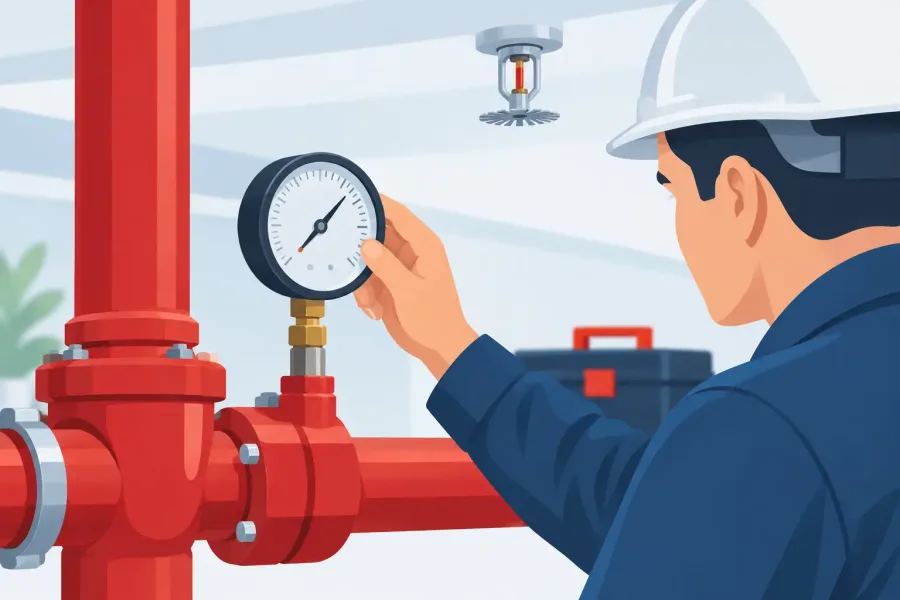
A sprinkler riser can look perfectly serviceable while a gauge quietly gives the wrong answer. A cracked lens, a stuck pointer, or a gauge that no longer returns to zero can turn a routine inspection into a missed impairment. Knowing how to test sprinkler gauges gives inspectors, technicians, and facility teams a practical way to catch that problem before it affects a decision on site.
Gauge work is simple in principle, but the details matter. A pressure reading only has value when the gauge is readable, appropriate for the pressure range, and accurate enough to support the inspection or service being performed. Treat the gauge as part of the system, not as a decoration on the trim.
What It Means to Test Sprinkler Gauges
Testing a sprinkler gauge is more than looking at the number on its face. A visual inspection checks whether the gauge is damaged, leaking, corroded, improperly ranged, or difficult to read. A functional check looks for a pointer that moves normally and returns as expected. An accuracy test compares the installed gauge with a calibrated reference gauge.
For fire sprinkler systems, NFPA 25 addresses the recurring requirement directly: pressure gauges are generally replaced every five years or tested every five years by comparison with a calibrated gauge. The applicable adopted edition, local requirements, manufacturer instructions, and the authority having jurisdiction control the work. Do not assume a five-year interval overrides a condition that calls for earlier replacement.
That distinction matters. A gauge may be within its scheduled test period yet clearly unfit for service because the lens is broken or water is leaking at the connection. Conversely, a clean-looking gauge can still be inaccurate enough to mislead a technician during an inspection.
Start With the Reading in Context
Before isolating or removing anything, record what the system is telling you. Note the gauge location, the indicated pressure, the date, and the condition of the gauge. On a wet-pipe system, supply and system-side gauges may show different pressures depending on the arrangement and system condition. On dry, preaction, or deluge equipment, air and water pressures have their own expected relationships.
There is no universal "correct" pressure for every sprinkler system. A 65 psi reading may be normal at one riser and a concern at another. Compare the reading to prior inspection records, design information when available, valve status, and the operating condition of the system. A sudden change deserves investigation, but changing a gauge without understanding the reason for the reading can hide a larger issue.
Also check the gauge range. The normal operating pressure should fall within the useful middle portion of the dial, not crowd the maximum value. A gauge that is routinely near full scale is harder to read accurately and may be more likely to suffer damage from pressure surges.
How to Test Sprinkler Gauges by Comparison
The most defensible field method is a comparison against a calibrated master gauge with a suitable pressure range and current calibration documentation. The reference gauge must be more accurate than the gauge being evaluated. A gauge of unknown condition is not a reference, even if it happens to agree with another unknown gauge.
Work only within your scope of responsibility and with the system condition understood. Isolating a gauge or manipulating a valve can affect supervision, impair a fire protection system, or create a leak path if it is done carelessly. Follow site procedures, notify the appropriate parties, and restore all equipment to its normal condition when the work is complete.
A practical comparison test follows a clear sequence:
- Inspect the installed gauge, its fitting, and any gauge valve for damage, leakage, corrosion, or obstruction.
- Connect or install the calibrated reference gauge so both gauges are measuring the same pressure source.
- Allow the pressure to stabilize, then compare readings without forcing or tapping the gauge to make the pointer move.
- If the system arrangement allows, observe the gauges at more than one pressure point during controlled testing or servicing.
- Record the installed gauge reading, the reference reading, the difference, the reference gauge identification, and the final disposition.
The acceptable tolerance should come from the applicable standard, the gauge type, and the procedure being used. Avoid using a casual rule such as "close enough" when the reading supports a fire protection decision. If the installed gauge is outside the permitted tolerance, replace it or take the corrective action required by the governing procedure.
Do not confuse a pressure switch test with a gauge accuracy test. A pressure switch may operate at its expected setting while the nearby gauge is inaccurate. Both devices can affect how the system is evaluated, but they are verified differently.
Signs a Sprinkler Gauge Should Be Replaced
Replacement is often the sensible answer, especially when the cost and labor are low compared with the uncertainty of leaving a questionable gauge in service. Replace a gauge that is damaged, leaking, unreadable, out of tolerance, or missing required markings. A pointer that stays above zero after pressure is relieved is also a clear warning sign.
Watch for a fogged lens, a bent case, a cracked window, corrosion at the bottom connection, or a dial face that has faded beyond easy reading. These are not cosmetic issues when the gauge must be read in a dim riser room or during a service call. If the pointer jumps, sticks, or reacts slowly to a known pressure change, the internal mechanism may be compromised.
A gauge exposed to freezing, vibration, physical impact, or repeated pressure cycling deserves extra scrutiny. Mechanical rooms and riser closets are rough environments. The fact that a gauge is still attached does not mean it is dependable.
Choose the Right Replacement Gauge
A replacement gauge needs to match the application, not just the thread size. Confirm the pressure range, connection type, dial size, environmental exposure, and listing or approval requirements for the installation. Use a gauge intended for fire protection service where required.
Range selection is a common mistake. A 0-300 psi gauge installed on a system that normally sits near 40 psi may be technically capable of measuring the pressure, but it offers poor resolution for routine observation. On the other hand, a gauge with too low a maximum rating can be damaged during normal system operation, a pressure surge, or testing.
When replacing a gauge, inspect the gauge valve or connection as well. A new gauge installed on a clogged, leaking, or seized valve does not solve the full problem. Make sure the replacement is oriented for reading, protected from damage where practical, and installed according to the applicable procedure.
Document the Test So the Next Person Can Use It
Good records make a gauge test useful after the technician leaves. At minimum, identify the building or system, gauge location, date, installed gauge reading, calibrated reference reading, reference gauge identification, result, and any replacement performed. Include observations such as leakage, damaged glass, or a pointer that failed to return to zero.
For recurring inspections, prior readings are valuable. They help distinguish a normal seasonal variation from a change that may point to a supply issue, a valve problem, an air maintenance issue, or a condition requiring further investigation. A single number is a snapshot. A history is evidence.
Common Questions About Testing Sprinkler Gauges
Do both sprinkler gauges need attention?
Yes. Where a system has multiple gauges, each gauge serves a purpose and should be inspected and tested or replaced on the required schedule. Agreement between two installed gauges is not proof of accuracy because both can drift in the same direction.
Can a technician tap a gauge to free the needle?
Tapping may reveal that a pointer is sticking, but it does not repair or validate the gauge. If a gauge only gives a believable reading after being tapped, treat it as suspect and evaluate it against a calibrated reference or replace it.
Is replacement better than testing?
It depends on the site, the gauge type, and the maintenance program. Comparison testing may make sense when records, calibration controls, and qualified personnel are already in place. Replacement can be faster and cleaner for ordinary field gauges, provided the new gauge is correct for the system and the work is documented.
A sprinkler gauge is a small component with a large job: it turns system pressure into a decision a person can act on. Keep the test method simple, use a calibrated reference, and replace doubt with a documented result before the next inspection depends on that dial.