
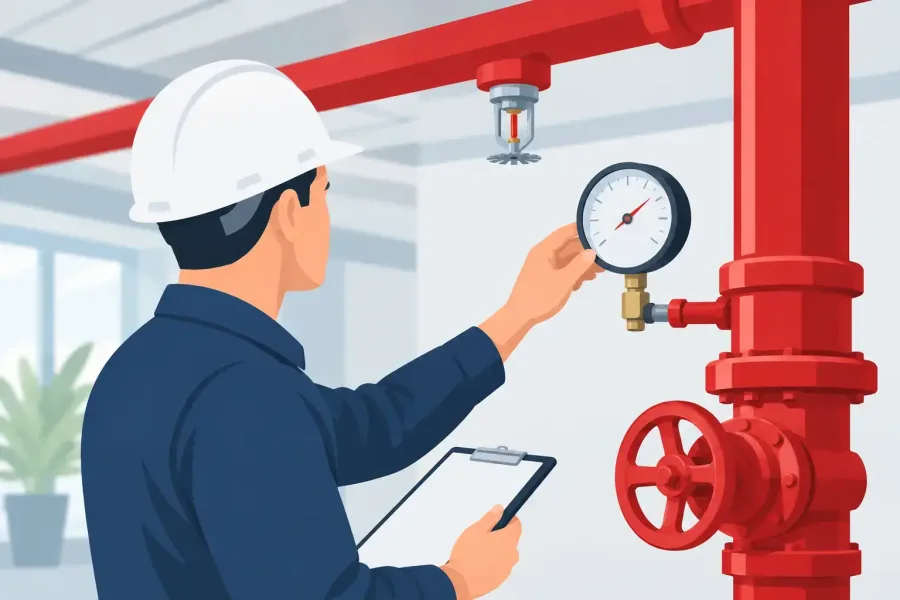
A sprinkler riser gauge can look fine while reporting the wrong pressure. That is why the answer to when are sprinkler gauges replaced is not simply “when they break.” Under NFPA 25, a system gauge generally must be replaced every five years or tested every five years against a calibrated gauge. The practical goal is simple: the pressure number used for inspection, impairment decisions, and troubleshooting needs to be trustworthy.
For inspectors, service technicians, and facility teams, this is a small requirement with big consequences. A bad gauge can hide a closed or partially closed valve, a supply issue, an air-pressure problem on a dry system, or a pump condition that deserves attention.
The five-year sprinkler gauge rule
NFPA 25 requires gauges to be replaced every five years or tested every five years by comparison with a calibrated gauge. If a gauge does not agree closely enough with the calibrated reference, it should be replaced.
This is often called the five-year gauge requirement, but the choice between replacement and testing matters. Replacement is straightforward: remove the old gauge, install a suitable new one, and record the date. Testing can reduce unnecessary replacement, especially where a site has many gauges, but it requires a known-accurate calibrated reference gauge and a documented process.
Always work from the edition of NFPA 25 adopted by the local jurisdiction, along with the facility’s inspection, testing, and maintenance program. The authority having jurisdiction, insurer, owner, or contract specification may require a more specific method or shorter interval.
What counts as a sprinkler system gauge?
The rule applies to gauges used to show pressure in water-based fire protection systems. Common examples include gauges on wet-pipe sprinkler risers, dry-pipe valves, preaction systems, alarm valves, fire pump suction and discharge piping, and pressure-reducing valves.
Different systems can have different operating pressures and different reasons for monitoring them. A 40 psi wet-system riser gauge and a dry-system air gauge do not tell the same story. Still, both need to provide a reliable reading when personnel compare current conditions to normal conditions, nameplate data, or prior test records.
Do not assume every round dial in a mechanical room is covered by the same requirement. Confirm what equipment the gauge serves, which standard governs that equipment, and whether it is part of the fire protection system inspection scope.
Replace it or test it: choosing the practical path
For many contractors, scheduled replacement is the cleanest option. Gauges are relatively inexpensive compared with a return trip, a questionable inspection result, or the time needed to establish traceable calibration. Replacement also avoids relying on an old gauge that may have been exposed to vibration, freezing, corrosion, pressure spikes, or physical damage.
Testing makes sense when a contractor or facility has a calibrated master gauge, follows a controlled procedure, and keeps good records. The comparison should be made under conditions that allow a meaningful reading. A gauge should not be declared accurate based on a quick glance at another aging gauge mounted beside it.
The trade-off is administrative as much as technical. If you test instead of replace, the record needs to show that the reference gauge was calibrated and that the system gauge was compared at the required interval. If those records are incomplete, replacement is usually the easier path to defend during an audit or inspection review.
Replace gauges sooner when conditions call for it
Five years is not a promise that a gauge will remain serviceable for five years. Replace a gauge immediately when it is damaged, leaking, unreadable, corroded, fogged, has a broken lens, a bent pointer, or an obviously incorrect reading.
A gauge also deserves attention when the pressure changes unexpectedly. Before treating the gauge as the problem, verify system status. Check control valves, water supply conditions, fire pump operation where applicable, dry-system air supply, and recent impairment or maintenance activity. Then compare the suspect gauge against a calibrated reference.
A gauge that pegs at zero, remains stuck at one pressure, or has a pointer that does not return normally should not be trusted. Neither should a gauge with a scale that is poorly matched to the expected operating pressure. A properly selected gauge should allow normal pressure to be read clearly, rather than crowding the needle against either end of the dial.
A field-ready way to handle the five-year requirement
The best time to manage gauge replacement is before the annual inspection turns into a record chase. During a site visit, identify each sprinkler-system gauge, note its location and service, and determine whether the five-year replacement or comparison date is due.
When replacing a gauge, first make sure the work can be done without creating an unrecognized impairment. Many gauges are installed with a gauge valve or cock that permits isolation. Follow the facility’s impairment procedure when necessary, notify the appropriate parties, and restore the system carefully after the work is complete.
Use a gauge rated for the service and pressure range involved. This is not a place for a random spare from the truck. Consider the connection size, mounting arrangement, scale range, environmental exposure, and whether the gauge is intended for fire protection service. On dry and preaction systems, be especially careful not to create an unintended air loss or trip condition.
After installation, return the gauge valve to its normal position, check for leakage, and verify that the reading makes sense for the system’s known condition. A new gauge does not eliminate the need for judgment. If the new reading differs sharply from the old one, investigate rather than simply assuming the old gauge was wrong.
What to document after replacement or testing
Good gauge records help the next technician understand what happened without guessing. They also make it easier to plan future inspections and demonstrate compliance.
At minimum, the service record should identify the gauge location or system, the date, whether it was replaced or tested, and the result. For a comparison test, identify the calibrated reference gauge used and record the comparison outcome. For replacement, record enough information to show the new gauge is suitable for the application.
If a gauge was replaced because of damage or inaccurate readings, add a short note explaining the condition found. That note can matter later if the facility is trying to understand a pressure discrepancy, recurring corrosion issue, or history of mechanical-room damage.
A practical tag or digital asset record can keep the five-year date visible. The key is consistency. A technician should be able to walk into the building, match the gauge to the record, and know whether it is current without reconstructing years of paperwork.
Common mistakes that create avoidable problems
The most common mistake is treating the annual visual inspection as if it resets the five-year requirement. It does not. A gauge can be readable and show a plausible pressure while still being overdue for replacement or calibrated comparison.
Another mistake is comparing one unknown gauge to another unknown gauge. If neither reference is calibrated, the comparison does not establish accuracy. The same problem occurs when a technician uses a pressure reading from memory rather than a documented normal condition.
It is also easy to overlook gauges outside the main riser room. Fire pump rooms, floor control assemblies, dry valves, pressure-reducing stations, and remote system components may all have gauges that need to be included in the facility’s tracking program.
Finally, do not confuse a gauge issue with a system-pressure diagnosis. A low reading might be a faulty gauge, but it could also indicate a real supply, valve, pump, or air-maintenance issue. Confirm the instrument first, then troubleshoot the system with the right test method and impairment controls.
Why this small task matters on exam questions and jobsites
Questions about sprinkler gauges often test whether you know the distinction between routine visual inspection and the periodic requirement for replacement or calibrated comparison. The useful memory point is five years, with two compliant paths: replace the gauge or test it against a calibrated gauge.
On the job, the same rule protects better decisions. Pressure readings affect how technicians evaluate sprinkler systems, dry valves, pumps, and water supplies. A gauge is inexpensive. Confidence in the number it displays is not. Build the five-year date into the site record, and the next inspection becomes a quick verification instead of an avoidable deficiency.