A fire safety reference app review should start in the place these tools are actually used: a concrete stairwell, a mechanical room, a riser closet, or a jobsite with one weak bar of service. A reference app is useful when it helps a technician verify a detail quickly without turning a five-minute question into a hunt through menus, downloads, or unrelated content.
For fire alarm, sprinkler, inspection, ERCES, and electrical professionals, the best apps are not replacements for adopted codes, engineering judgment, plans, permits, or the authority having jurisdiction. They are working tools. Their job is to put organized reference material, formulas, definitions, and study support within reach when the paper binder is back in the truck or the signal has disappeared.
What a Fire Safety Reference App Should Do
The first question is simple: what problem does the app solve? “Fire safety” is a broad label. A product may focus on fire alarm inspection points, sprinkler terminology, NFPA-related reference material, hydraulic calculation support, code-study flashcards, or general workplace safety. Those are different jobs, and a good review separates them.
For a field technician, speed matters. Search should find a term as it is commonly spoken on the job, not only if the user enters a perfect formal phrase. A reference section should be arranged around recognizable topics such as notification appliances, inspection and testing, valves, standpipes, supervision, batteries, pathways, or radio coverage. If every answer is buried under several taps, the app may be accurate but still be frustrating to use under pressure.
Scope matters just as much. An app that clearly states what it covers is more trustworthy than one that claims to cover every code, system, and jurisdiction. A fire alarm technician needs different detail than a sprinkler fitter, and an ERCES technician needs different information than someone preparing for a basic safety credential. Narrow, useful coverage beats a giant, vague library.
Fire Safety Reference App Review: The Field Test
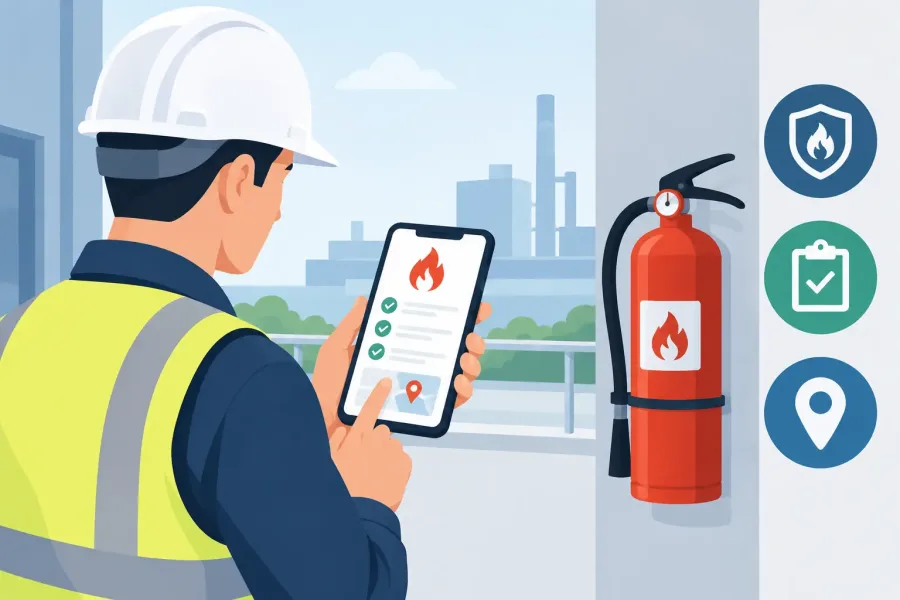
A practical review should test the app against ordinary field questions. Can a user locate a definition while standing beside a panel? Can they check a formula without a connection? Can they move from a search result to related material without losing their place? Can they read the screen with gloves off, dirty hands, and limited time?
Offline access is a major differentiator. Basements, hospitals, high-rise cores, new construction, and rural sites are not friendly to cloud-only tools. If an app requires a sign-in or data connection just to open a saved reference, it creates a failure point where reliability matters most. Offline-first design also means fewer distractions: no loading ads, no popups competing with the information, and no waiting for a page to refresh.
That does not mean every offline app is automatically better. Reference material must still be maintained. A useful app should identify its edition, source basis, or update date where appropriate. Older material can be valuable for study or general orientation, but it should never be mistaken for the currently adopted requirement on a specific project. Local amendments, contract documents, manufacturer instructions, and the AHJ can change the answer.
A strong review also checks readability. Dense technical content is unavoidable sometimes, but the interface should not add more friction. Clear headings, readable type, sensible contrast, and predictable navigation are practical features, not decoration. A good field app gets out of the way.
Reference Content Is Not the Same as Code Access
This distinction protects both the user and the work. NFPA standards and related documents are copyrighted, edition-specific materials. An app may provide educational summaries, terminology, study prompts, checklists, or curated reference content, but users should know whether they are reading the actual adopted standard, a summary, or a training aid.
For exam preparation, a summary can be exactly the right format. It can help a candidate remember inspection intervals, understand system components, practice calculations, and recognize the type of question a NICET exam may ask. For final design decisions, acceptance testing, or compliance disputes, the technician should go back to the governing documents and project requirements.
The best reference apps make this boundary obvious. They do not pretend that a short screen can settle every code interpretation. Instead, they help the user arrive at the right question faster. That is a meaningful advantage on a busy service call.
Search, Calculators, and Study Tools Need Different Standards
Not every feature should be judged the same way. Search is about retrieval. A user should be able to enter “smoke detector spacing,” “tamper,” or “battery” and get useful results without guessing the developer’s preferred wording. Search that tolerates partial terms is especially helpful for apprentices still learning formal vocabulary.
Calculation tools require a higher level of care. Inputs should be labeled plainly, units should be visible, and the result should be easy to check manually. A calculator that produces a number without showing what the number represents can cause more trouble than it prevents. The app should also make clear when its result is an aid for estimation or study rather than a stamped design calculation.
Practice questions belong in their own lane. Good exam prep does more than reward memorization. It explains why an answer is right, exposes weak areas, and uses timed simulations when the real exam is timed. Real-length mock exams are useful because endurance is part of test performance. A candidate who understands the material but runs out of time still has a problem to solve.
TapForge Studios builds its trade tools around that practical split: offline reference and field utility on one side, focused certification study on the other. That approach makes sense because a technician on a jobsite and a candidate preparing for a NICET exam may use the same phone, but they are not asking it to do the same job.
Where Apps Fall Short
A reference app cannot inspect an installation, verify a device listing, interpret a site-specific sequence of operations, or replace communication with the AHJ. It also cannot guarantee that a broad rule applies unchanged to every occupancy, jurisdiction, or edition.
Users should be cautious with apps that hide their content source, have no visible update history, or lean on generic safety language while offering little trade-specific detail. Be equally cautious with apps that promise code compliance from a single calculator result. Fire and life-safety work deserves better than a confident-looking shortcut.
There is also a trade-off between depth and speed. A compact app may be excellent for quick definitions and common calculations but insufficient for complex design review. A larger library may contain more information but become slow to search on a jobsite. The right choice depends on whether the user needs daily field backup, exam practice, or a portable supplement to formal code access.
A Better Buying Decision
Before installing or purchasing a fire safety reference app, picture the last three questions you needed answered in the field or while studying. Then look for an app that addresses those questions directly. If you routinely troubleshoot fire alarm panels, prioritize fast terminology and system references. If you work with sprinklers, look for content that reflects inspection, valves, components, and the calculations or concepts you actually use. If you are testing, prioritize explanations, question volume, timed practice, and progress tracking.
A paid app can be the better value when it is ad-free, usable offline, and focused on a real task. Free tools are not automatically a bad choice, but ads and connectivity requirements can be a poor fit around life-safety work. The useful measure is not the download price. It is whether the app saves time, improves recall, and stays available when the jobsite does not cooperate.
Keep the official documents, plans, and manufacturer data close for decisions that carry compliance or safety consequences. Let the app handle the fast lookup, the practice session between calls, and the everyday questions that should not require a signal to answer.