
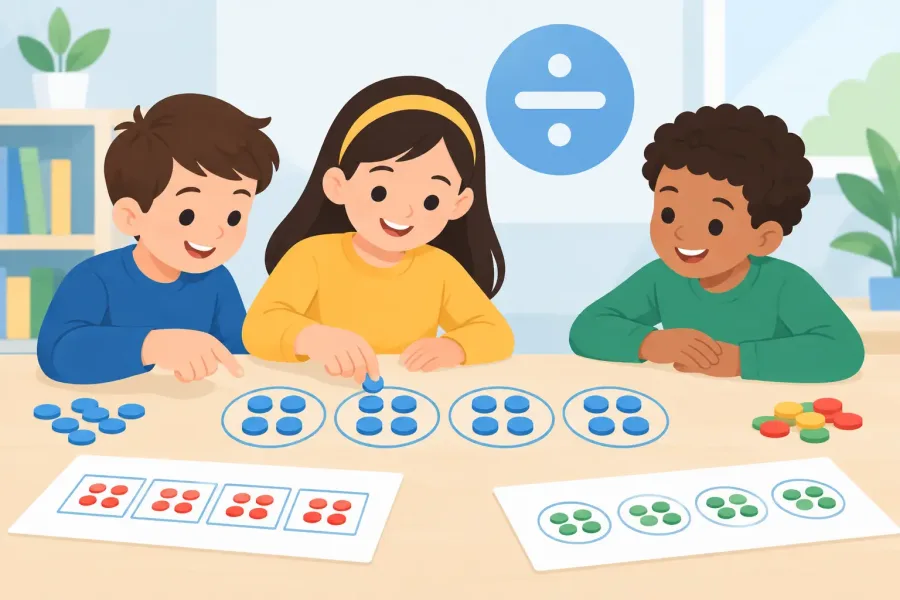
A child can recite a division fact one minute and freeze when the same fact appears in a word problem the next. That gap is why the best kids division games do more than reward quick taps. They give children a reason to sort, share, group, estimate, and try again without turning every missed answer into a red X.
For parents and teachers, the right game is not necessarily the flashiest one. It is the one that matches the skill a child is learning right now, keeps the math visible, and makes practice easy to repeat. Offline, ad-free games are especially useful for car rides, waiting rooms, after-school practice, and classrooms where a distracting pop-up is the last thing anyone needs.
What the best kids division games actually teach
Division is not one skill. A student first needs to understand equal groups: 12 cookies shared among 3 friends means each friend gets 4. Then come fact families, such as 4 x 3 = 12 and 12 ÷ 3 = 4. Later, children need to handle leftovers, larger numbers, and word problems that require them to decide whether to divide at all.
A useful game should make one of those ideas clear. If every round mixes arrays, long division, fractions, timers, and story problems, a child may be entertained but not actually practicing the weak spot. Look for short rounds, immediate feedback, and a way to adjust difficulty as confidence grows.
The 10 game styles below cover the progression from concrete sharing to stronger problem solving. They work as ideas for choosing an app, building a classroom center, or making a quick paper-and-pencil activity at home.
1. Equal-share sorting games
Start with a simple question: Can the child split a collection evenly? In an equal-share game, players drag 15 apples into 3 baskets or deal 20 cards among 4 characters. The visual model matters because children can see why 15 ÷ 3 equals 5.
This is one of the best choices for early learners and for older children who have memorized facts without understanding them. Keep the numbers small at first. The goal is not speed. It is recognizing that division means making equal groups.
2. Missing-factor fact games
Division facts become less mysterious when children see multiplication and division as connected. A game might show 24 ÷ 6 = ? or 6 x ? = 24, then ask the player to choose the matching answer. Switching between the two formats helps facts stick.
These games work well after a child understands equal sharing. If a student is still counting every object one by one, go back to visual grouping before pushing fact fluency.
3. Array builder challenges
Arrays turn a fact into a rectangle. For 18 ÷ 3, a child can build three rows with six items in each row. For 20 ÷ 5, they can make five equal rows of four. This helps children connect division to multiplication, area models, and later work with factors.
An effective array game should let children create the model instead of only looking at one. Building, moving, and checking the rows gives the answer a physical logic that a multiple-choice screen cannot always provide.
4. Division bingo
Bingo is simple, fast, and surprisingly flexible. Put quotients on the board, call out division problems, and let players cover the right answer. A child who needs more support can use a fact chart; a child ready for more challenge can solve problems with larger dividends.
This format is best for review rather than first instruction. It has enough repetition to strengthen recall, but it does not explain why a fact works. Pair it with a quick visual example when a child repeatedly misses the same family of facts.
5. Remainder rescue games
Remainders deserve their own practice. Many children understand 14 ÷ 3 until they have to explain what happens to the two left over. A good remainder game asks players to sort objects into equal groups, then decide what to do with extras.
Make the story match the answer. If 14 students ride in vans that hold 3 each, the answer is 5 vans, not 4 remainder 2. If 14 stickers are shared among 3 children, the answer may be 4 each with 2 left over. The best games show that the context changes the final answer.
6. Race-the-clock fact practice
Timed games can build automatic recall, but they are a tool, not a test of worth. A short 30- or 60-second round can help a child practice facts they already understand. It should never be the first exposure to division or the only measure of progress.
Choose a game that allows a child to race their own earlier score instead of competing only against others. That keeps the focus on growth. If timing creates frustration, turn it off and use accuracy goals instead.
7. Grocery and sharing story games
Word problems are where division leaves the worksheet and starts making sense. A game might ask how many packs are needed for 36 juice boxes if each pack holds 6, or how many cookies each table receives when 28 cookies are shared by 4 tables.
The strongest story games use ordinary situations and clear wording. Avoid games that pile irrelevant details into every question. Children should be practicing math reasoning, not decoding a confusing paragraph.
8. Quotient matching puzzles
Matching games are useful for quiet practice. Children pair a division problem with its quotient, a picture with an equation, or a multiplication fact with its related division fact. The puzzle format slows the experience down enough for kids to notice patterns.
This works especially well for students who know some facts but mix up nearby answers, such as 42 ÷ 6 and 42 ÷ 7. Repeated matching makes those relationships easier to separate.
9. Long-division step games
Once students move beyond basic facts, they need more than answer drills. Long-division games can break the process into manageable choices: divide, multiply, subtract, bring down, and repeat. A good version highlights the current step rather than revealing the entire solution at once.
There is a trade-off here. Step-by-step support prevents a child from getting lost, but too much help can become button-following. Look for practice that gradually removes prompts as the learner becomes more capable.
10. Build-your-own division quests
A child who creates a problem often understands it more deeply. In a build-your-own quest, kids choose a total, a number of groups, and a story setting, then challenge a parent, sibling, or classmate to solve it. They might create a pet-supply store, a space mission, or a snack stand.
This is a strong finishing activity because it reveals whether the child understands the relationship between dividend, divisor, and quotient. If their story says 17 astronauts are split evenly into 5 ships, ask what the remainder means. That conversation is valuable practice, not a detour.
Choosing a division game for your child
Pick one game style based on the skill that needs work, not just the grade level printed on the screen. A child struggling with 24 ÷ 4 may need equal-group visuals. A child who gets facts right but misses word problems may need more practice interpreting what the answer means.
Also check the environment around the game. Ads, internet prompts, reward videos, and crowded menus can pull attention away from the math. Family-safe, offline-first learning tools keep practice available when Wi-Fi is weak and keep children focused on the actual task. TapForge builds its educational apps with that practical, ad-free approach in mind.
A good division game should leave a child with one useful thought: division is a problem I can figure out. Choose a format that makes that thought repeatable, then let small wins build into real confidence.