
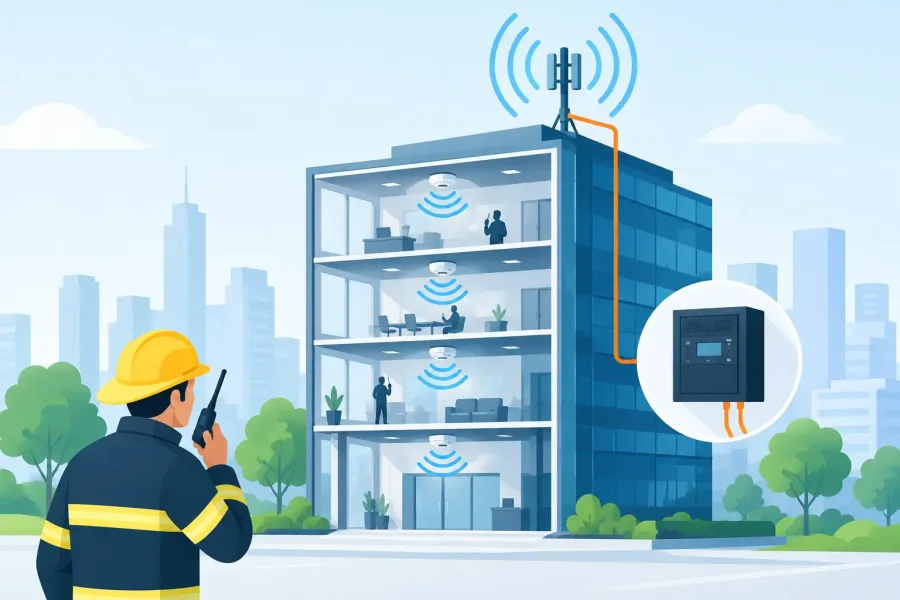
A firefighter can have a working portable radio at the front door and lose it two floors below grade. Concrete, steel, low-E glass, stair enclosures, and dense utility spaces can all weaken radio signals fast. That is the problem behind ERRCS system basics: providing dependable in-building radio coverage for first responders when the public-safety signal outside does not carry where it is needed.
ERRCS is often used interchangeably with ERCES, or Emergency Responder Communication Enhancement System. The name varies by jurisdiction, project documents, and local code language, but the job is the same. The system is built to support emergency responder radio communications inside a building during an incident.
For electricians, fire alarm technicians, low-voltage installers, inspectors, and NICET candidates, ERRCS sits at the intersection of radio-frequency work, life-safety supervision, fire alarm interfaces, construction coordination, and acceptance testing. It is not simply a signal booster mounted in an electrical room.
What an ERRCS system is designed to do
An ERRCS improves two-way radio coverage between responder radios inside a structure and the outside public-safety radio network. It may be required in high-rise buildings, hospitals, large commercial sites, underground areas, parking garages, or any building where coverage testing shows weak signal performance.
The exact requirement is local. The authority having jurisdiction, commonly called the AHJ, may enforce provisions based on adopted fire code, building code, NFPA standards, local amendments, and the communications requirements of the fire department or radio system owner. That means a setup accepted in one county may not be acceptable a few miles away.
The key point is that ERRCS is intended for emergency operations, not everyday cellular service. A cellular distributed antenna system and a public-safety ERRCS may use similar-looking equipment, but they are separate systems with different frequencies, approvals, monitoring expectations, and stakeholders.
ERRCS system basics: the equipment path
Most active ERRCS installations begin with a donor signal. This is the usable public-safety radio signal received outside the building, often through a donor antenna located on the roof or another approved exterior location. The system brings that signal into a bi-directional amplifier, usually called a BDA.
The BDA amplifies both the downlink and uplink paths. Downlink sends radio traffic from the outside radio network into the building. Uplink sends transmissions from responders inside the building back to the outside network. Both directions matter. Good reception without a reliable return path is not usable radio coverage.
From the BDA, coaxial cable, fiber, or a combination of pathways distributes the signal to interior antennas. These antennas are placed to cover the areas identified in the design and verified through testing. A typical system may also include a battery backup, automatic transfer or dedicated power arrangements, surge protection, remote annunciation, supervisory monitoring, and a fire alarm interface.
A basic equipment lineup often includes:
- An exterior donor antenna that receives and transmits approved public-safety frequencies
- A BDA that amplifies the authorized radio bands in both directions
- Interior donor or coverage antennas, cable, splitters, couplers, and related pathway components
- Power, backup power, annunciation, and monitoring equipment that keeps the system supervised
Every component must be selected for the project, the radio bands, the building layout, and the adopted requirements. Installing a generic amplifier without radio-system coordination can cause harmful interference, which is one reason ERRCS work requires more than ordinary low-voltage wiring knowledge.
Passive and active distribution
Smaller buildings may use passive coax distribution. The BDA feeds splitters, taps, and interior antennas through carefully calculated coaxial runs. Cable loss, connector quality, antenna gain, and distance all affect the final signal level.
Larger buildings may use fiber-fed remote units or other active distribution methods. Fiber can reduce loss over long distances and support wider coverage, but it adds equipment, power needs, pathways, supervision, and commissioning steps. Neither approach is automatically better. The right choice depends on size, construction, frequency range, coverage objectives, and the local radio authority's requirements.
Coverage is measured, not assumed
A floor plan is not proof of coverage. ERRCS acceptance depends on field measurements using approved procedures and equipment. Technicians test defined areas, commonly using a grid or other method required by the AHJ or radio authority, and document signal strength, audio quality, bit error rate, delivered audio quality, or other applicable performance measures.
The testing method matters because public-safety radio systems are not all alike. Analog and digital systems can have different acceptance criteria. A technician must also test the actual approved frequency bands and channels, not just confirm that the BDA powers up.
Weak areas often appear where crews need communication most: fire command rooms, stairwells, elevator lobbies, electrical rooms, basements, parking structures, mechanical penthouses, and rooms behind rated or reinforced assemblies. A building can look well-covered on an open office floor yet fail badly in a stair enclosure.
Testing is also why design changes late in construction can be expensive. Added concrete, metal wall systems, elevator equipment, racking, or tenant improvements can alter radio propagation. Early coordination gives the ERRCS designer room to adjust antenna locations and pathways before ceilings close.
Supervision, alarms, and survivability
Because ERRCS supports life safety, the system is usually monitored for conditions that could affect operation. Common supervisory or trouble conditions can include AC power loss, low backup battery, amplifier failure, donor antenna trouble, active component failure, and wiring or pathway issues. The exact points reported and the method of reporting depend on the adopted requirements and approved design.
The fire alarm system may receive ERRCS trouble or supervisory signals through monitored connections. Do not treat that connection as an afterthought. It needs coordination between the ERRCS installer, fire alarm contractor, electrical contractor, general contractor, and inspector. Labeling, point descriptions, sequence documentation, and final functional testing need to agree.
Pathway survivability is another major design issue. If fire damages the cable route or disables the amplifier during an incident, indoor coverage can disappear when it is needed most. Codes and local requirements may address protection for circuits, equipment rooms, backup power, and cable pathways. The required approach can differ by building type and jurisdiction, so the approved plans and AHJ direction control the work.
Design starts with the local radio authority
The biggest ERRCS mistake is treating it as a catalog purchase. Before equipment is ordered, the project team needs to know which frequencies are authorized, whether a donor signal is available, what radio system serves the area, what interference controls apply, and who has authority to approve the design.
Some jurisdictions require coordination with the public-safety radio system owner before installation. Others have specific requirements for installer qualifications, equipment listings, permits, plan review, acceptance testing, and recurring testing. A BDA that is technically capable may still be rejected if it is not approved for the local system or installed outside the permitted design.
For trade professionals, this is where clean documentation earns its keep. Keep current drawings, equipment data, frequency information, battery calculations where applicable, test records, cable labels, antenna locations, and monitoring point details organized from the start. It saves time during inspections and makes future service far less guesswork-driven.
Common field problems to catch early
Poor donor signal is a frequent issue. If the outside signal is too weak, unstable, or obstructed, no amount of interior antenna placement can fully solve the problem. Donor antenna location and directional alignment may be as important as the interior layout.
Improper gain settings create another problem. Too little gain can leave coverage gaps. Too much gain can cause oscillation or interference. Gain, isolation, cable loss, and antenna placement have to work together, and adjustments should be made by qualified personnel following the approved design.
Power and monitoring details also get missed during rushed closeout. A system may have excellent measured coverage but fail acceptance because backup power, annunciation, labeling, fire alarm reporting, or required documentation is incomplete. Treat the system as a supervised life-safety installation from rough-in through final test.
What technicians should remember
ERRCS work rewards methodical habits. Verify the approved radio bands before pulling cable. Protect pathways before finishes are installed. Coordinate roof work, grounding, power, fire alarm points, and equipment-room access early. Then test, document, correct, and retest instead of assuming an installed antenna equals a covered area.
The practical lesson is simple: emergency radio coverage is a performance requirement, not a box on a plan. Learn the local rules, understand the signal path, and keep records that let the next technician see exactly how the system was built. When a building is under stress, clear radio communication is one system nobody wants to troubleshoot for the first time.