
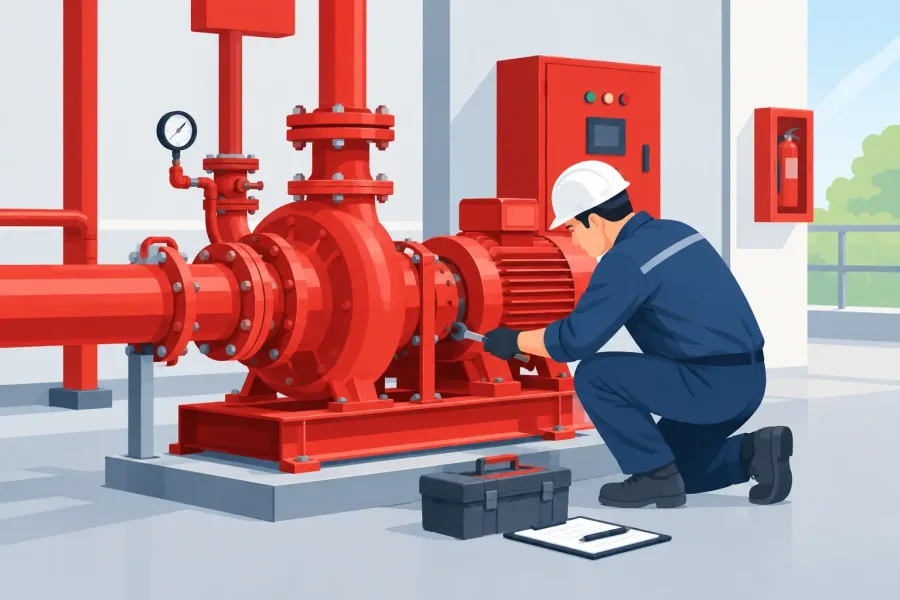
A fire pump can sit quiet for months, then become the most important piece of equipment in the building during a fire. That is why a fire pump maintenance guide cannot be treated like a generic equipment checklist. The goal is not simply to prove the pump starts. The goal is to confirm that water supply, driver, controller, valves, alarms, and operating conditions will work together when the sprinkler or standpipe system needs them.
For technicians, inspectors, and facility teams, the practical standard is simple: know what normal looks like, test at the required interval, document the result, and act before a small defect becomes an impairment. NFPA 25, the adopted local code, the pump manufacturer, and the authority having jurisdiction all shape the final program. Use the requirements that apply to the specific building and installation.
Start With the Fire Pump System, Not Just the Pump
A fire pump is part of a larger water-based fire protection system. A good maintenance plan begins by identifying the equipment arrangement and the conditions that could keep it from delivering water. Review the pump nameplate, controller data, approved plans when available, acceptance test records, and the last inspection reports. Those documents establish the rated flow, rated pressure, driver type, normal valve positions, and known deficiencies.
Walk the room before touching the controller. The fire pump room should be accessible, protected from storage, adequately lit, and maintained within the environmental limits for the equipment. A room used as a spare-parts closet creates more than a housekeeping problem. It can block emergency access, hide leaks, damage components, and make a routine inspection less reliable.
Check the suction and discharge piping for physical damage, leakage, vibration issues, and missing gauges. Verify that required valves are in their normal position, supervised where required, and readily accessible. A closed or partially closed control valve can make a perfectly healthy pump useless.
For diesel-driven units, look beyond the engine itself. Fuel, batteries, cooling water, oil, belts, exhaust, and ventilation all matter. For electric-driven units, focus on the electrical supply, controller status, battery or backup arrangements where provided, room conditions, and signs of overheating or moisture. The inspection points overlap, but the failure modes do not.
Fire Pump Maintenance Guide: Routine Checks That Matter
Routine inspection is where most avoidable problems are found. Do not rely on a quick glance at a green light. Read the controller indicators, inspect the gauges, and compare what you see with prior records. A slow pressure change or repeated alarm may be the first clue that something upstream needs attention.
A useful routine check should cover at least these four areas:
- Pump and piping: Look for leaks, corrosion, loose fittings, abnormal vibration, damaged couplings, and unusual noise.
- Controller and alarms: Confirm the controller is in automatic operation, review alarm or trouble indications, and make sure no unauthorized settings have been changed.
- Water supply and valves: Check gauge readings, tank or source conditions where applicable, and the normal position of supervised valves.
- Pump room conditions: Remove storage, verify heat and ventilation, check for water intrusion, and keep access routes clear.
Record actual readings rather than writing only OK. Suction pressure, discharge pressure, churn pressure, battery voltage, fuel level, engine temperature, and test duration create a trend history. A single number may be within an acceptable range, while a steady decline over several inspections signals trouble.
Frequency depends on the driver type, system arrangement, adopted edition of NFPA 25, manufacturer instructions, and local enforcement. Electric motor-driven pumps and diesel engine-driven pumps do not always follow the same exercise schedule. Do not assume a monthly test applies to every pump or that every weekly task can be consolidated into a monthly visit. Confirm the required interval for the installed equipment.
Exercise the Pump Without Creating an Impairment
A no-flow, or churn, test verifies that the fire pump starts and operates under controlled conditions without flowing water through the system demand. The test is valuable, but it is not a substitute for a flow test. A pump can start normally at churn and still fail to deliver its rated performance under load.
Before a scheduled test, verify that the test setup is safe and that required notifications have been made. Follow the site's impairment procedures if a portion of the fire protection system will be out of service or affected. During the run, listen for abnormal sounds, watch pressure behavior, and check for overheating, leakage, vibration, or controller trouble signals.
Diesel testing deserves extra attention. An engine that starts but has weak batteries, low fuel, a cooling problem, or an exhaust restriction is not ready for a long fire event. Watch the engine during the full test period, not just during startup. Return the equipment to automatic service afterward and confirm that all valves, controllers, and alarms are back in their normal condition.
Annual Flow Testing Shows Real Pump Performance
Annual flow testing is the performance check that separates a running pump from a capable pump. It compares the pump's output at churn, rated flow, and often an overload point against the pump's expected curve and prior test data. This work typically requires qualified personnel, proper calibrated test equipment, a safe discharge arrangement, and enough water supply to conduct the test correctly.
The numbers must be interpreted, not merely collected. Low suction pressure can point to a water supply issue. Reduced discharge performance can involve the pump, driver speed, an obstructed suction path, a valve condition, damaged impeller components, or inaccurate instrumentation. A change in one result may not identify the exact cause, but it tells the owner that investigation is needed.
Compare annual results to the original acceptance test and previous annual tests. Trending is often more useful than arguing over one borderline reading. A gradual loss in capacity is easier and cheaper to address before it becomes a failed test or an emergency repair.
Do not make casual adjustments to pressure relief valves, controller settings, pump speed, or other calibrated components just to improve a test result. Those changes can create a different problem elsewhere in the system. Diagnose the cause, use qualified service personnel when needed, and document the corrective action.
Records Turn Testing Into Maintenance
A fire pump log should allow another qualified person to understand what happened without guessing. Keep inspection forms, weekly or monthly test records, annual flow test reports, repair invoices, controller event history, battery service records, and documentation of impairments or notifications together. Digital records are useful, but a paper log available at the equipment can still be valuable when connectivity is poor or a technician is working in a mechanical room.
Good notes are specific. Write that the diesel pump started automatically in 4 seconds, ran for the required duration, showed no alarms, and had a recorded suction and discharge pressure. If a condition is abnormal, record what was found, who was notified, the corrective action, and whether the system remained in service.
This documentation protects more than compliance. It gives the next technician a baseline, helps facility managers plan repairs, and gives inspectors a clear picture of whether deficiencies are being handled.
Common Problems Worth Catching Early
Most fire pump issues begin as ordinary maintenance defects: weak batteries, dirty strainers, fuel contamination, small packing leaks, corroded terminals, room heaters that have failed, or valves moved during unrelated work. None sounds dramatic on its own. Any one can become serious when the system is needed.
Treat recurring controller alarms seriously, even if the pump appears to run normally. Repeated phase reversal, power loss, low battery, low fuel, overspeed, or fail-to-start events are not paperwork annoyances. They are evidence that the system is asking for attention.
If a pump cannot be returned to normal service, follow the building's impairment plan immediately. Notify the appropriate people, establish the required temporary safeguards, arrange repair, and restore protection as soon as possible. Never leave an impaired fire protection system uncommunicated.
The best fire pump program is not flashy. It is a disciplined routine of clean rooms, real readings, correct testing, and records that make changes visible. When the pump is finally called on, that quiet work is what gives the building a fighting chance.