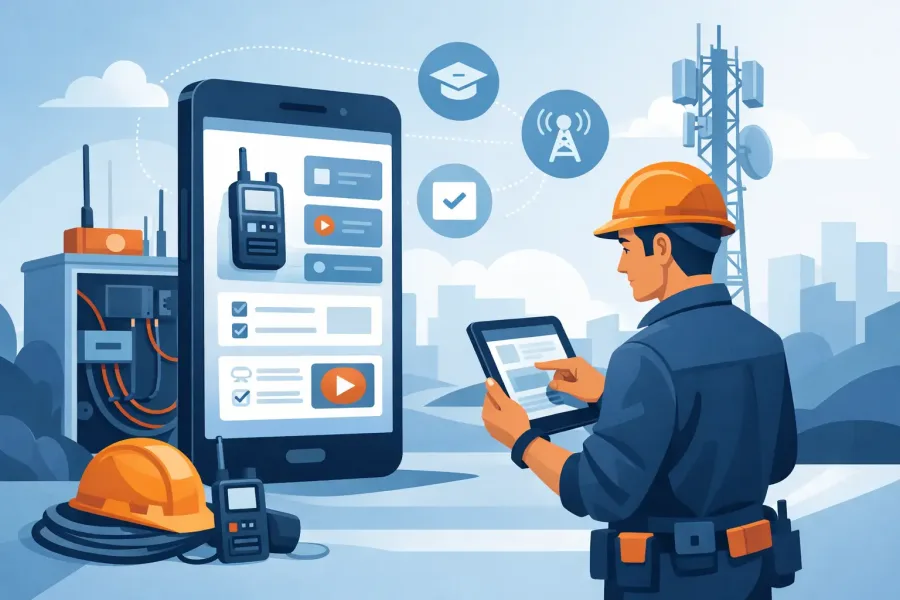
A basement mechanical room is a poor place to discover that your study material needs a signal. An ERCES technician training app gives technicians a practical way to review system concepts, code-related terminology, testing steps, and troubleshooting logic without depending on Wi-Fi, cell service, or a browser that keeps timing out.
ERCES work is specialized, detail-heavy, and tied to real life-safety outcomes. You may be preparing for a credential, learning a new part of the trade, supporting an installation team, or trying to make better sense of acceptance-test results. In each case, the right training tool should help you retain useful knowledge quickly, then carry it into the field.
What ERCES Technicians Need to Know
An emergency responder communication enhancement system, often called ERCES or ERRCS, supports radio communications for first responders inside buildings where normal radio coverage is weak. The work can involve signal surveys, donor antennas, bi-directional amplifiers, fiber or coax pathways, remote units, annunciation, supervision, battery backup, and ongoing inspection or testing requirements.
That range is exactly why studying from disconnected notes can become inefficient. A technician needs more than a few definitions. They need to understand how the pieces relate to one another.
For example, a low battery or AC-loss condition is not just an alarm point to memorize. It affects system supervision, annunciation, maintenance response, and the confidence that a system will operate during an emergency. A weak area on a coverage test is not automatically solved by adding equipment. The cause could involve pathway losses, antenna placement, building changes, donor-signal conditions, or a design issue that needs review.
Training works best when it connects terminology to the decisions technicians make on real jobs.
Why an Offline ERCES Technician Training App Fits the Trade
ERCES technicians do not always study at a desk. They study before a shift, in a truck, between service calls, during travel, and after a long day when a short practice session is more realistic than an hour-long course.
An offline-first app is built for those moments. It keeps core material available in areas where connectivity is limited or prohibited, including parking garages, high-rise cores, utility spaces, rural jobsites, and secured facilities. It also removes the distraction of advertisements, pop-ups, account prompts, and endless browser tabs.
That does not mean an app replaces project documents, approved plans, manufacturer instructions, or requirements from the authority having jurisdiction. It does not. ERCES requirements can vary by adopted code edition, local amendments, fire department policy, radio system, and project scope. A training app should build understanding and improve recall, while the current approved documents remain the source for job-specific decisions.
The trade-off is simple: a focused offline tool is excellent for structured practice, but it cannot know every local condition. Good technicians use both. They build their base knowledge with repeatable study, then verify the requirements that govern the building in front of them.
Study the System, Not Just the Vocabulary
Flashcards can help with terms, but ERCES training should not stop there. The material needs to reinforce the logic behind a system.
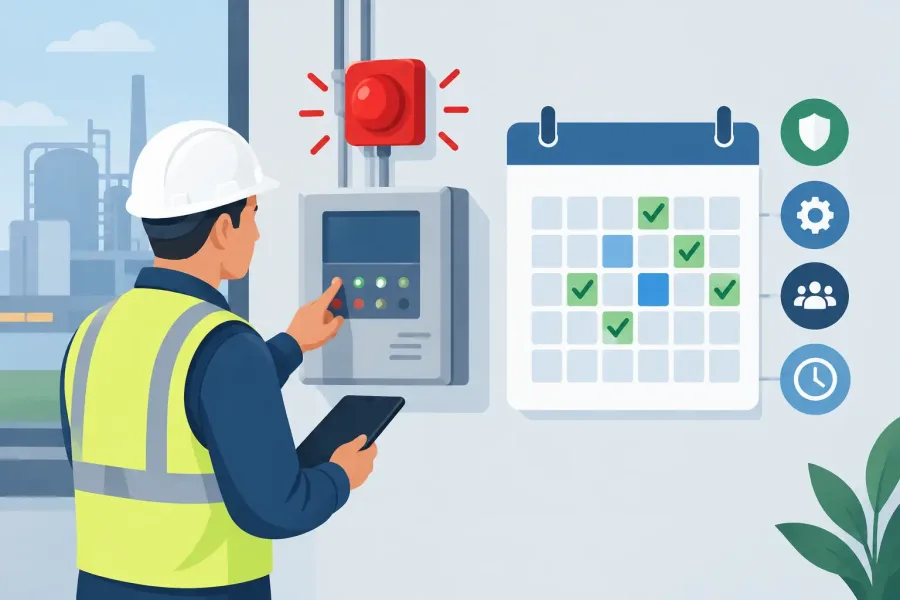
Start with the signal path. Consider how a public-safety radio signal reaches the building, how it is received or transported, how amplification and distribution are arranged, and how the system reaches critical areas. Then study the supervision path: what conditions are monitored, where they report, how they are annunciated, and what response a reported trouble condition should trigger.
Next, work through power. Technicians should be comfortable separating normal power from secondary power, recognizing the purpose of standby capability, and understanding why battery calculations and charging conditions matter. The exact requirements depend on the applicable standards and local rules, but the underlying principle stays the same: life-safety support equipment must be monitored and maintained, not assumed to be ready.
Finally, study performance verification. Coverage, signal strength, audio quality, channel requirements, and testing documentation may all be part of a project. A good training question asks more than, “What does this acronym mean?” It asks what a result suggests, what should be documented, and who needs to be involved before a change is made.
Use Practice Questions to Find Weak Spots
Practice questions are useful when they are specific enough to expose a knowledge gap. If you miss a question about annunciator signals, do not simply memorize the answer. Go back and identify the system purpose behind it. If you miss a question about testing, ask whether the problem was terminology, sequence, documentation, or an assumption about a code requirement.
This approach makes study time more productive. It also prevents a common problem in certification preparation: scoring well on familiar question wording but struggling when the same concept appears in a field scenario.
Timed practice has value too, especially for technicians preparing for an exam. But timing should come after comprehension. First learn why an answer is correct. Then use timed sessions to practice reading carefully, separating relevant facts from distractions, and moving on when a question is taking too long.
Build a Study Routine That Survives Field Work
The best study plan is not necessarily the longest one. It is the one a working technician can repeat.
A practical routine might be 15 to 20 minutes at a time, four or five days a week. One session can focus on system components. The next can cover power and supervision. Another can use scenario-based questions on inspections, documentation, or troubleshooting. Short sessions make it easier to review missed questions while the topic is still fresh.
Keep a simple record of trouble areas. If you repeatedly miss questions involving radio-frequency basics, pathway components, or acceptance testing, that is your next study block. Do not spend equal time on every topic just because it feels organized. Spend more time where your answers show uncertainty.
It also helps to connect study with the work you see. After servicing a cabinet, reviewing a trouble condition, or observing a test, take a minute to name the concepts involved. Was that a supervision issue? A power issue? A signal-distribution question? Field experience sticks better when it has a clear mental category.
What to Look for in an ERCES Training Tool
A useful app should be focused. It should organize content in a way that lets a technician move from quick review to deeper practice without hunting through unrelated material. Searchable references, question review, progress tracking, and realistic practice sessions can all help, but only if the material is clear and relevant.
Offline access matters because it protects study time from the conditions of the job. So does privacy. A training tool should not need to collect more personal information than necessary just to let a technician answer practice questions.
Look for plain language alongside correct trade terminology. ERCES has enough acronyms already. Training content should explain terms without talking down to experienced technicians or leaving newer apprentices behind. It should also make a distinction between broad study concepts and requirements that must be confirmed in the adopted code, project specification, and local AHJ direction.
TapForge Studios builds Android tools around that field-first idea: practical study and reference support that remains available offline, built by hand without ad clutter.
Turn Training Into Better Jobsite Decisions
The point of ERCES training is not to sound sharper in a meeting. It is to reduce avoidable mistakes before they reach a test report, an inspection, or an emergency event.
A technician who understands the relationship between components can ask better questions when drawings, field conditions, and equipment behavior do not line up. They are more likely to notice a missing label, an unexplained trouble signal, a questionable pathway change, or documentation that does not match what was tested. They also know when the right next step is escalation rather than guesswork.
That habit matters. ERCES systems sit at the intersection of communications, electrical work, fire and life safety, construction coordination, and local approval. No app can replace experience or authority, but consistent practice can make experience more useful.
Keep the training tool on your phone, use it in the small gaps between jobs, and let every missed question point to the next thing worth learning.