
A child who knows that 4 x 6 = 24 has already done much of the work needed for 24 ÷ 6. The trouble starts when division is presented as a fresh stack of facts to memorize. If you are figuring out how to teach division facts, start by showing children that division is multiplication viewed from the other direction: it asks how many groups, or how many in each group.
That idea matters more than speed in the beginning. A child may recite division facts but freeze when a word problem says, “Twenty-four markers are shared equally among six kids.” Another child may count through the answer slowly but fully understand what the equation means. Build meaning first, then use practice to make the facts easier to retrieve.
Start with Equal Groups, Not Flash Cards
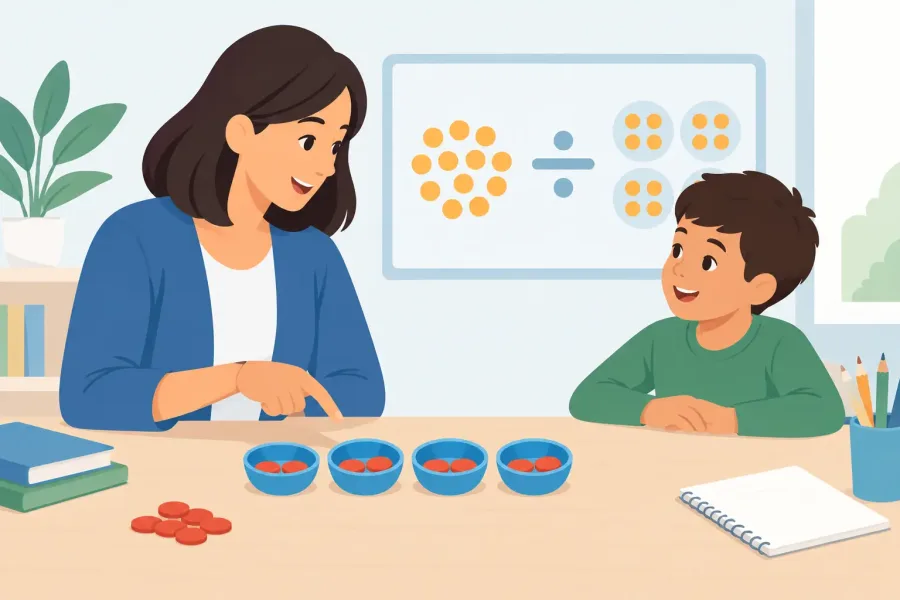
Division has two related meanings, and children need experience with both. In sharing division, the total is split into a known number of equal groups. For 12 ÷ 3, put 12 counters on the table and share them among three plates. Each plate gets four counters, so 12 ÷ 3 = 4.
In grouping division, the group size is known and the question is how many groups can be made. With 12 ÷ 3, place 12 counters in groups of three. Count the groups: one, two, three, four. The answer is still four, but the story is different.
Use whatever is already close at hand: buttons, coins, crackers, building bricks, pencils, or small toy cars. The object is not to make a craft project. It is to let a child touch and see the quantity while they say the math aloud: “Twelve shared among three groups is four in each group.”
Once the physical model feels familiar, draw it. A quick sketch of 15 dots circled in groups of five can represent 15 ÷ 5. Then write the equation beside it. This concrete-to-picture-to-symbol progression gives a child somewhere to go when a fact does not come back instantly.
Connect Division Facts to Multiplication Facts
The fastest sensible route to division fluency is usually multiplication fluency. Treat the facts as families rather than isolated cards. For the numbers 3, 5, and 15, write these four related equations:
- 3 x 5 = 15
- 5 x 3 = 15
- 15 ÷ 3 = 5
- 15 ÷ 5 = 3
Ask questions in both directions. “Three groups of what make 15?” “If 15 is split into groups of three, how many groups are there?” This keeps the equal sign and the operation symbols meaningful instead of decorative.
A multiplication chart can also become a division tool. To solve 42 ÷ 6, have the child find the 6 row and ask which number multiplied by 6 makes 42. They will find 7. Over time, they should rely less on the chart, but it is a useful bridge while facts are still forming.
Be careful with the common instruction to “just think multiplication.” It works well once a child knows enough multiplication facts to search mentally. If multiplication is weak, return to groups, arrays, skip-counting, and a chart. Asking for instant recall before the underlying facts exist turns practice into guessing.
Teach Division Facts in a Useful Order
Do not hand a child every fact from 1 through 12 and expect equal progress. Start with divisors that reveal patterns and build early wins. Division by 1 is the same number. Division by itself gives 1. Division by 2 connects to halves, and division by 5 often connects to familiar counting patterns.
Then work on 10, 3, 4, 6, 8, 9, 7, 11, and 12 in an order that fits the child’s multiplication knowledge. There is no prize for following a rigid sequence. A student who knows the 3s and 4s well can use them to reason through 12s. For example, 48 ÷ 12 may be hard as a standalone fact, but four groups of 12 make 48.
Focus on one small family at a time. A short session might include 18 ÷ 3, 21 ÷ 3, 24 ÷ 3, and 27 ÷ 3, along with the matching multiplication facts. Finish with a mixed question or two from earlier families so older learning stays active.
Use Arrays and Number Lines for Stubborn Facts
Arrays make the inverse relationship visible. Arrange 24 counters into six equal rows. Each row has four counters, which shows 24 ÷ 6 = 4. Turn the arrangement and you can also see 24 ÷ 4 = 6. One model explains two division facts and two multiplication facts.
Number lines are especially useful for grouping division. To find 28 ÷ 4, make equal jumps of four from 0 to 28. Count the jumps: seven. This is slower than recall, and that is fine. It gives a reliable strategy for facts that have not become automatic yet.
Children should not be told that counting is “wrong.” Counting is a starting strategy. The goal is to replace repeated counting with known facts, patterns, and efficient reasoning. Praise the strategy first, then help them notice a faster connection: “You made seven jumps of four. That is also because 7 x 4 = 28.”
Build Recall With Short, Varied Practice
Facts become automatic through repeated successful retrieval, not through one exhausting worksheet. Five to ten focused minutes most days usually works better than a long session once a week. Keep the practice mixed enough that the child must think, but not so mixed that every question feels unfamiliar.
Try a simple call-and-response game while packing lunches or driving home. Say, “Thirty-six divided by six,” and let the child answer. If they hesitate, give a prompt instead of immediately supplying the answer: “What times six equals 36?” When they answer, ask them to explain the connection once in a while.
Card games work well when the cards are used for thinking, not just racing. Put multiplication facts on one set of cards and matching division facts on another. A child finds the pair for 7 x 4 = 28 and 28 ÷ 7 = 4. For extra challenge, have them make the full fact family.
A quick written check can be useful, but do not make every practice session timed. Timed practice measures recall speed, which can help after understanding is secure. Used too early or too often, it can make a capable child anxious and hide what they actually know. A better approach is to track personal improvement: fewer prompts, more facts remembered, or a slightly faster finish than last week.
Keep Word Problems Close to Real Life
Division facts stick when children see what they solve. Ask practical questions: “We have 30 strawberries and five bowls. How many go in each bowl?” Or, “There are 32 stickers. If each page holds four, how many pages can we fill?” Have the child identify whether they are sharing into a set number of groups or making groups of a set size.
Use remainders only after the basic fact is clear. For 14 ÷ 4, make three full groups of four and notice that two are left. Say the answer in context: “Three groups, with two left over.” This prevents a child from assuming every division problem must come out evenly.
For families who want screen practice, an ad-free, offline math app can be useful for short review sessions, especially when it includes read-aloud support or printable follow-up work. Tools such as Mathlings should support hands-on explanation and conversation, not replace them. A child learns more from explaining why 35 ÷ 5 equals 7 than from tapping the right answer five times.
Watch for the Mistakes That Need a Reteach
Some errors point to a specific missing idea. If a child answers 24 ÷ 6 = 30, they may be adding instead of thinking about equal groups. If they answer 24 ÷ 6 = 6, they may be repeating a number from the problem without understanding which number is the quotient. Put counters back on the table and ask them to build the situation.
If a child confuses 24 ÷ 6 and 6 ÷ 24, use a story. Twenty-four cookies can be shared into six groups. But six cookies cannot be split into groups of 24 without introducing fractions. Context makes the order of the numbers matter.
Avoid telling children to memorize their way out of confusion. Memorization has a role, but it works best after the fact has a home in a model, a multiplication relationship, or a real situation.
A strong division fact is not just an answer delivered quickly. It is a child who can say, “I know 42 ÷ 6 is 7 because 6 x 7 is 42,” and can still build the groups if they need to. Keep that kind of reasoning in the daily routine, and speed will have something solid to stand on.