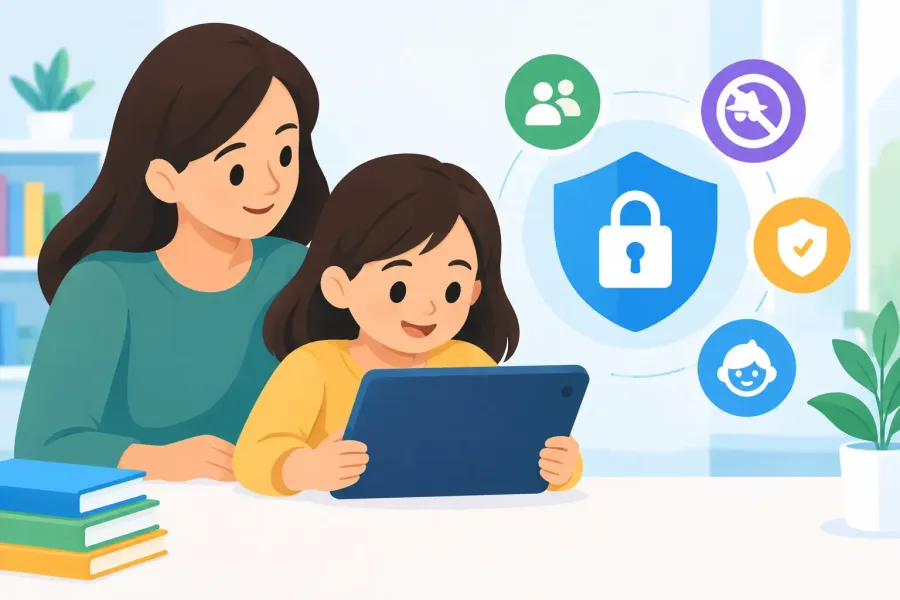

A good Spanish math app has a job to do: help a child understand the next math skill without adding ads, distractions, account problems, or another thing for a parent to manage. For many families, Spanish-language support is not an extra feature. It is what lets a child read directions confidently, practice independently, and bring school math closer to the language used at home.
That makes the right app less about flashy rewards and more about clear instruction, useful practice, and dependable access. Whether your child is working on multiplication facts, fractions, pre-algebra, or Algebra 1, the app should make it easier to build skill one problem at a time.
What a Spanish Math App Should Actually Do
Math apps can look similar in a store listing but work very differently once a child starts using them. Some offer a few translated labels around an English-first lesson. Others provide Spanish-language practice while keeping the math sequence clear enough for a student, parent, or teacher to follow.
For K-8 learners, the best starting point is an app that matches the skill in front of them. A third grader who needs multiplication fluency does not need a broad catalog of advanced lessons. They need enough well-built repetition to recognize patterns, correct mistakes, and gain speed without feeling rushed. A middle school student struggling with negative numbers needs explanations and practice that connect, not random questions mixed in with unrelated topics.
Spanish support should help the child understand what the problem is asking. It should not make the app harder to navigate. Clear labels, readable instructions, familiar math vocabulary, and a straightforward path from lesson to practice matter more than decorative animations.
Start With the Math Skill, Not the Screen Time
Before choosing an app, identify the exact skill that needs work. “Math” is too broad to produce a useful practice plan. A child may be doing well with addition but still freeze when regrouping appears. Another may understand fractions visually but struggle to compare denominators. The most useful practice is specific.
For younger students, common needs include number sense, addition and subtraction, multiplication, division, place value, and basic fractions. Older elementary and middle school learners may need fraction operations, decimals, ratios, expressions, equations, graphing, or pre-algebra foundations. Students entering Algebra 1 often benefit from practice that separates one skill at a time before combining them in larger problems.
A Spanish math app works best when it gives families a practical way to stay focused. Instead of assigning “play math for 30 minutes,” try a small goal: finish one multiplication set, answer ten fraction questions, or practice solving two-step equations until the child can explain the process. Short, regular sessions usually beat a long session once a week.
Look for Spanish Support That Is Useful at Home
The language choice in a math app can support more than the student. It can also help parents and caregivers participate in homework time, especially when they are more comfortable discussing math in Spanish.
Math vocabulary deserves attention because a small wording difference can change how a problem feels. Terms such as numerator, denominator, factor, quotient, inequality, and variable need to be presented consistently. A child should not have to guess whether the app is asking them to add, compare, simplify, or solve.
Read-aloud support can also be valuable for beginning readers, multilingual learners, and children who understand spoken Spanish more easily than written instructions. It is not necessary for every student, but it can remove a barrier when reading is getting in the way of measuring math understanding.
There is a trade-off. An app that is entirely in Spanish may be ideal for Spanish-language practice, while a bilingual approach may better support children who learn math at school in English but use Spanish at home. The right choice depends on how the child receives instruction, where confusion happens, and which language helps them feel most capable.
Why Offline Learning Matters for Families
An app should still work when the Wi-Fi does not. That is especially useful on road trips, in waiting rooms, after a move, during internet outages, or in households where several people share a limited connection.
Offline-first learning also means fewer interruptions. There is no need to stop a practice session because a page will not load, a video fails to play, or an account prompt appears. A child can open the app, work through problems, and put the device away.
For parents, offline use has a privacy benefit too. A learning tool does not need to follow a child around the internet to teach multiplication. An ad-free app avoids the awkward moment when a young learner taps a bright banner instead of the next question. It also keeps the session focused on math rather than on earning attention points for someone else.
TapForge Studios builds its Mathlings learning apps with that practical approach: family-safe math fun for kids, built by hand and designed to work offline. The goal is not to turn every problem into a spectacle. It is to give children clear practice they can return to whenever they need it.
Practice, Quizzes, and Worksheets Each Have a Place
A strong learning routine uses more than one type of activity. Practice questions help a child learn a skill. Quizzes check whether the skill holds up without hints. Printable worksheets provide a useful break from the screen and give parents or teachers something concrete to review.
The difference matters. If a child gets every answer right while receiving step-by-step prompts, they may still need independent practice before a quiz. If they do well on a quiz but cannot show their work on paper, it may be worth slowing down and checking whether they understand the process or simply recognize familiar question patterns.
Adaptive study plans can help when a child has several weak areas. Rather than manually deciding what comes next every day, families can use performance to guide the next set of questions. Still, automatic recommendations are a tool, not a verdict. A parent or teacher may know that a child is tired, frustrated, or working on a classroom unit that should take priority.
How to Build a Routine That Does Not Become a Fight
The best schedule is one a family can keep. For many children, ten to fifteen minutes of focused practice after school or before dinner is enough. The session should end while the child still has some attention left, not after frustration takes over.
Start with one familiar question or a quick review set. That early success helps a child settle in before facing a new skill. Then move into the target lesson or practice activity. If a mistake happens, avoid jumping straight to the answer. Ask what the question is asking, what information is known, and what operation might fit. Those small prompts build math language along with math confidence.
Rewards can help, but they do not need to be elaborate. Finishing a planned practice set, choosing the next worksheet, or seeing a streak of completed sessions can be enough. The real win is when a child starts saying, “I know how to do this one.”
Questions Parents Should Ask Before Choosing an App
A quick check can prevent an app download from becoming another unused icon. Ask whether the content fits your child’s current grade and skill level, whether Spanish instructions are clear and useful, and whether the app works without an internet connection. Check whether it has ads, recurring subscriptions, or features that require constant sign-in.
Also consider how progress is shown. A simple record of completed practice, quiz results, or missed problem types can be more helpful than a complicated dashboard. Parents need enough information to spot a pattern: multiplication facts are improving, fraction comparison needs more time, or equations are becoming less intimidating.
Finally, think about how the app fits with school. An app does not have to copy a classroom workbook exactly to be useful. But it should reinforce core skills in a way that makes homework, tests, and everyday problem-solving feel more manageable.
A Spanish math app earns its place on a child’s device when it makes practice calmer, clearer, and easier to repeat. Pick the skill, keep sessions short, and give your learner a tool that works when they are ready to learn - not only when the internet cooperates.