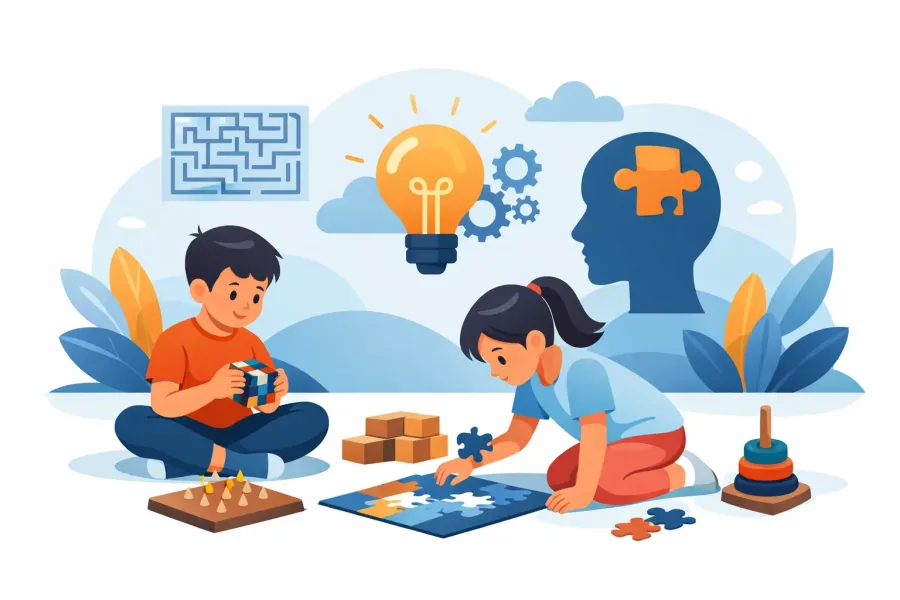
A good puzzle game does more than keep a child busy in the back seat or while dinner is cooking. The best puzzle games give kids a clear problem, enough information to make a smart choice, and a reason to try again when the first answer is wrong. That small cycle - notice, test, adjust, solve - is real practice for school and everyday thinking.
For families, the problem is not finding games. There are thousands of them. The challenge is finding ones that are age-appropriate, work without a signal, respect a child’s attention, and do not turn every mistake into a prompt to watch an ad or buy another chance. A puzzle game should feel like a game, not a storefront.
What Makes Puzzle Games Worth a Child’s Time
Puzzles work because they ask players to actively participate. A video can explain a concept, but a puzzle requires the child to make a decision. They may rotate a shape, find a pattern, plan a route, sort objects by a rule, or solve a number challenge. The answer is not handed to them. They have to build it.
That matters most when a game makes mistakes useful. If every wrong tap brings a loud failure screen, children can become cautious and start guessing less. Better games let them see what happened, change their approach, and try again quickly. The goal is not perfect performance on the first turn. It is building confidence that a difficult problem can be worked through.
Puzzle games can also support skills that show up beyond the screen. Pattern games strengthen observation. Logic puzzles encourage step-by-step reasoning. Number puzzles can make arithmetic feel less like a worksheet. Spatial challenges help children think about position, shape, and movement. None of these games replaces direct instruction, but they can make practice more inviting.
The fit depends on the child. A student who enjoys numbers may stay engaged with calculation puzzles, while another may prefer visual matching, word play, or maze-based challenges. The useful question is not, “Is this educational?” It is, “What kind of thinking does this game ask my child to practice?”
Choose Offline Puzzle Games With Fewer Distractions
Offline play is a practical feature, not a novelty. Families use phones and tablets in cars, waiting rooms, hotels, school pickup lines, and homes with unreliable service. An offline game starts when a child needs it, not when the device finds Wi-Fi.
It also gives parents more control. A fully offline game does not need to load fresh ads, push children toward outside content, or depend on a constant stream of notifications. That creates a calmer experience for kids and fewer surprises for adults.
Ad-free design matters for the same reason. Ads interrupt concentration at exactly the moment a child is trying to solve something. Worse, many free games use rewards, timers, and pop-ups to keep players tapping instead of thinking. There is a difference between a game that is replayable and one that is designed to create endless friction.
A paid, self-contained app can be a better value when it gives families clear content, no recurring subscription pressure, and no advertising. Price is still a consideration, especially for households buying apps for more than one child. But it is worth comparing the full experience, not just the download price. A low-cost app that works offline and stays out of the way can earn its place on a family device.
Match the Challenge to the Player
The best puzzle is neither automatic nor impossible. If a child solves every level without pausing, the game may be too easy to hold attention. If they cannot understand the rules or make progress after a few attempts, frustration can take over. Good puzzle games create a manageable stretch.
For younger children, clear visuals and simple rules matter more than complicated scoring systems. Matching, sorting, sequencing, and basic shape puzzles give them a chance to understand the goal quickly. Audio support can help early readers follow directions independently, though it should be optional when families need quiet play.
Elementary students can handle puzzles that combine several ideas. A game might ask them to recognize multiplication patterns, compare fractions, use clues to eliminate choices, or organize a sequence of moves. At this age, a little variety goes a long way. Repeating one skill can build fluency, but switching between related challenge types keeps practice from feeling stale.
Older kids usually respond well to puzzles with real strategy. They may enjoy planning ahead, managing limited moves, spotting hidden relationships, or solving problems under light time pressure. Time limits are not always the right choice, however. They can add energy for one child and anxiety for another. A strong app lets the challenge come from the puzzle itself rather than from a countdown clock.
Look for Design That Respects Attention
A well-made puzzle game explains its rules through play. The first few levels should teach one idea at a time, then gradually add a new constraint. Children should not need a parent beside them to translate a crowded screen or explain a confusing menu.
Simple design is especially valuable on smaller Android screens. Buttons should be large enough to tap accurately. Text should be readable. Important information should not compete with decorative animations. When the screen is busy, kids can lose track of the actual problem they are meant to solve.
Feedback should be specific enough to help. In a math puzzle, for example, a child benefits more from seeing that a choice does not match the rule than from a generic red X. In a logic game, hints should point toward the next useful observation without completing the puzzle for them. Too many hints make a game passive. No help at all can leave a child stuck.
Replay value also deserves a close look. Some games have a fixed set of levels, which can be fine when the puzzles are carefully designed and reasonably priced. Others use shuffled challenges, score goals, or multiple difficulty settings to stay fresh. Neither approach is automatically better. A fixed collection can feel polished and purposeful, while randomized play can support short daily practice. The right choice depends on whether your child wants a new experience each time or likes improving at familiar challenges.
Use Puzzle Play as Part of a Healthy Routine
Puzzle games work best when they have a clear place in the day. They can be a quiet option after school, a travel activity, or a short break between homework tasks. They do not need to become a reward for every routine, and they do not need to run for an hour to be useful. Ten focused minutes can be plenty.
Parents can get more from a game by asking one or two simple questions afterward: “What clue helped you solve that?” or “What did you try when the first answer did not work?” These questions shift attention from winning to thinking. They also help children notice the strategies they can use in math, reading, and other schoolwork.
For kids who need extra academic practice, look for games that connect play to a specific skill without burying that skill under distractions. Mathlings, for example, is built around child-friendly math practice with offline play, ad-free use, and activities that make room for learning by playing. A game does not have to look like a worksheet to reinforce a useful idea.
A Better Standard for Kids’ Games
The strongest puzzle games give children a fair challenge, a clear goal, and room to learn from a wrong answer. They should work when the internet does not, avoid ads that break concentration, and offer enough variety to earn repeat play.
When a child closes a game feeling more capable than when they opened it, that is a better result than another streak, another pop-up reward, or another request to keep watching. Choose games that make thinking feel satisfying, then let the next puzzle do its job.