
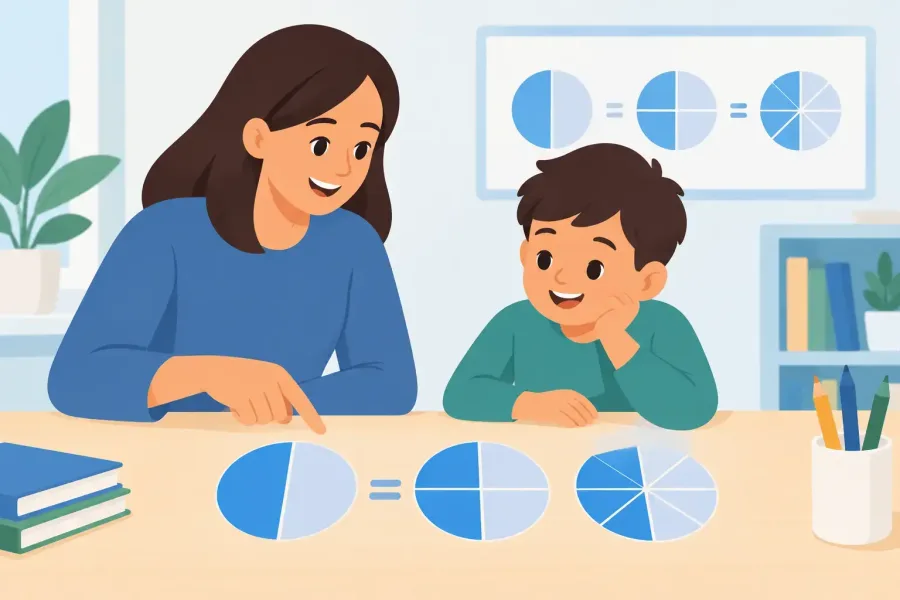
A child can look at 1/2 and 2/4 and reasonably ask, “How can those be the same? They do not even look alike.” That question is the right place to start. Knowing how to teach equivalent fractions means helping kids prove that two fractions name the same amount, not asking them to memorize a multiply-and-divide trick before the idea makes sense.
Equivalent fractions are a major turning point in elementary math. Students need them to compare fractions, find common denominators, add and subtract unlike fractions, and understand ratios later on. When the foundation is visual and hands-on, the procedures that follow feel logical instead of arbitrary.
Start With One Whole and a Clear Question
Before showing several fractions at once, establish the nonnegotiable rule: every fraction model must use wholes of the same size. A half of a small cookie is not equal to a half of a large pizza. Kids often understand the numerator and denominator separately but miss the fact that fractions describe parts of one specific whole.
Use a paper rectangle, a strip of cardstock, or a simple drawing. Shade one of two equal parts and label it 1/2. Then divide each half into two equal pieces. Nothing about the shaded area changes. It is still half of the rectangle, but there are now four equal pieces and two are shaded. That is 2/4.
Ask questions that keep the focus on quantity:
- Did we shade more of the whole?
- Did the whole get bigger or smaller?
- How many equal pieces are there now?
- How many of those pieces are shaded?
The useful conclusion is not just “1/2 equals 2/4.” It is: “We split every piece into smaller equal pieces, so the number of pieces changed, but the amount did not.”
How to Teach Equivalent Fractions With Visual Models
Fraction strips are one of the cleanest tools for this lesson because students can line up equal lengths. Make strips representing one whole, halves, thirds, fourths, sixths, eighths, and tenths. They do not need to be fancy. Paper strips with careful folds and labels work well.
Place a 1/2 strip under a whole strip. Then place two 1/4 pieces under the same whole. When the endpoints align, the evidence is right in front of the student: 1/2 and 2/4 cover the same distance. Repeat with 1/3 and 2/6, then 3/4 and 6/8.
Area models work especially well for students who respond to pictures. Draw identical rectangles or circles, partition each one equally, and shade matching amounts. Rectangles are usually easier than circles because children can divide them into equal parts more accurately. A rectangle split into six equal sections makes 3/6 easier to see than a loosely drawn pizza.
Use more than one model, but do not race through every model in one sitting. Some kids see equivalence quickly with strips; others need a grid or a number line. The goal is not variety for its own sake. The goal is giving students a way to verify that the fractions represent the same quantity.
Add the Number Line Early
A number line prevents a common misconception: that fractions are only shaded shapes. Mark 0 and 1, then locate 1/2. Next, divide the same distance into fourths and locate 2/4. Both land on the same point.
This matters because a fraction is also a number. When students later compare 3/4 and 5/8, or work with improper fractions, the number line gives them a reliable sense of size. It also makes an excellent quick check. If two fractions are equivalent, they must occupy the same location on a number line.
Move From Pictures to the Multiplication Pattern
Once students can show why 1/2 equals 2/4, connect the visual change to notation. In the example, the numerator changed from 1 to 2 and the denominator changed from 2 to 4. Both were multiplied by 2.
Write it clearly:
1/2 × 2/2 = 2/4
Explain that 2/2 equals one whole. Multiplying by one does not change a number’s value. It only changes how the amount is named. This explanation is stronger than saying, “Whatever you do to the bottom, do to the top,” although that shortcut is useful after the concept is secure.
Continue with a few examples where the multiplier is obvious:
2/3 = 4/6 because both parts are multiplied by 2.
3/5 = 9/15 because both parts are multiplied by 3.
Then reverse the direction. Show that 8/12 can be simplified to 2/3 by dividing both the numerator and denominator by 4. Students should understand that simplifying fractions and creating equivalent fractions are the same relationship viewed in opposite directions.
Avoid teaching cross multiplication as the first test for equivalence. It can check an answer, but it does not build meaning. A child may correctly calculate that 2 × 6 equals 3 × 4 without understanding why 2/3 and 4/6 name the same amount.
Use Real Contexts, Then Check the Math
Food examples are familiar, but they can become messy when portions are not actually equal. Use them carefully. A brownie pan cut into eight equal pieces is better than a pizza drawing with uneven slices.
Other contexts often work just as well. Four of eight players wearing red jerseys is the same portion as one of two. Six of twelve tiles covered on a game board is equal to one half. A recipe that calls for 2/4 cup of an ingredient can use 1/2 cup instead.
The context should support the fraction, not replace it. After a short story problem, bring students back to the model or number line. Ask them to show how they know the amounts are equal. This keeps the lesson from becoming a guessing game based on familiar words.
Build Practice That Requires Thinking
Worksheets have a place, especially after students have handled models. But pages full of isolated problems can hide whether a child understands the idea. Mix visual, verbal, and numerical tasks.
Ask a student to draw a model for 3/4 and then create an equivalent fraction. Ask which fraction does not belong in a group such as 1/2, 3/6, 4/8, and 4/6. Ask them to place 2/3, 4/6, and 6/9 on one number line. These tasks reveal whether the student can reason rather than only multiply.
A simple matching game also works well. Put fraction cards such as 1/2, 2/4, 3/6, and 4/8 in one set, and visual models in another. Students match equal values and explain one match aloud. The explanation matters. “They are both shaded the same” is a start; “Each piece was split into two, so there are twice as many total and shaded parts” is stronger.
For independent practice, short sessions usually beat one long drill. A few focused problems, immediate feedback, and a chance to redraw a model can keep frustration low. An offline, ad-free math practice tool such as Mathlings can also give families a contained way to repeat fraction skills without turning practice time into distraction time.
Watch for the Mistakes That Signal a Gap
When a child says 1/2 is smaller than 1/4 because 2 is smaller than 4, return to fraction strips. They are comparing the denominator as a whole number rather than thinking about the size of each piece. More pieces means each piece is smaller, assuming the whole stays the same.
Another frequent mistake is changing only one part of the fraction, such as claiming 1/2 equals 1/4. Have the student shade both fractions. The models quickly show that the amount changed. Reinforce that equivalent fractions require multiplying or dividing both the numerator and denominator by the same nonzero number.
Some students can generate equivalents but cannot identify the simplest form. Give them a practical test: “Can both numbers be divided by the same number greater than one?” If yes, the fraction can be reduced. If not, it is simplified. Factor lists can help older elementary students, but younger learners often benefit more from grouping counters or using familiar multiplication facts.
Know When to Stop Adding New Rules
It is tempting to introduce equivalent fractions, simplifying, common denominators, and fraction addition in one unit. For some students, that works. For others, it creates a pile of rules with no stable picture underneath.
Pause before moving on if a student cannot explain why 2/4 equals 1/2 using a drawing, a strip, or a number line. They do not need polished vocabulary. They do need to recognize that the same whole can be partitioned in different ways without changing the amount.
A strong equivalent-fractions lesson ends with a child looking at 3/6 and saying, “That is one half because the whole was split differently.” That sentence is more useful than a page of correct answers, because it gives them a reason they can carry into every fraction skill that comes next.