
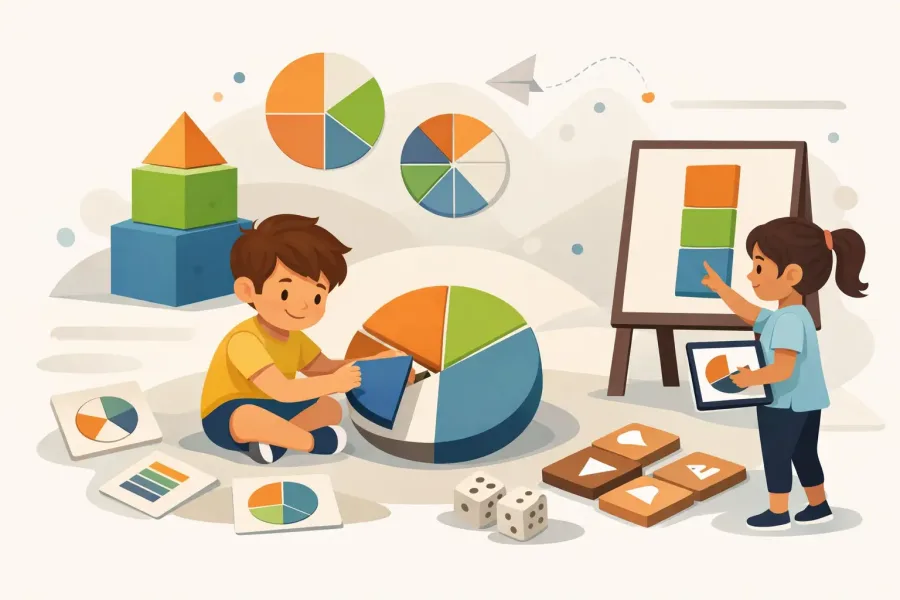
A child can shade three of four pizza slices without hesitation, then freeze when asked to write 3/4. That gap is where the best fraction games kids play earn their place. A useful game does not just reward a fast tap or a lucky guess. It helps children connect the picture, the words, and the number.
For parents and teachers, the goal is not to turn every math lesson into screen time. It is to give fraction practice a clear job: make an abstract idea visible, repeat it without boredom, and show where a child needs more help. The right game can do that in a few focused minutes, especially when it works offline and stays free from ads, pop-ups, and distractions.
What good fraction games for kids actually teach
Fractions are not one skill. A child may understand that one half means two equal pieces, but still struggle to compare 2/3 and 3/4. Another may identify a fraction on a picture but not know how to add fractions with the same denominator. Treating all fraction practice as the same thing can hide those differences.
Good fraction games start with equal parts. Kids need to see that halves, thirds, fourths, sixths, and eighths describe pieces of one whole divided fairly. A circle split into uneven sections is not a useful fraction model, even if it looks colorful. Accuracy matters because children build later skills on this first idea.
From there, the game should move through a sensible sequence. First comes identifying fractions with shapes, number lines, and everyday objects. Next comes matching models to symbols, comparing simple fractions, and finding equivalent fractions. Operations belong later, once the child can explain why 1/2 and 2/4 name the same amount.
A game can be playful without being random. A character collecting fraction pieces, a puzzle that fills a number line, or a quick quiz that earns a new level can all work. The game mechanic should support the math instead of covering it up.
Choose games by the skill your child needs
Before downloading another app or printing another worksheet, watch what happens when your child answers a fraction question. Are they guessing from the size of the numbers? Do they count shaded pieces but ignore the total? Do they know the answer when they see a picture but not when the fraction is written alone? Those details point to the kind of practice that will help.
Building the meaning of fractions
For beginners, choose activities that use fraction bars, circles, grids, and simple number lines. The child should make or select the fraction, not only hear whether an answer is right. For example, showing 3/5 with five equal boxes and asking a child to shade three creates a stronger connection than asking them to memorize a definition.
Food examples can help, but they should not carry the whole lesson. Pizza and cookies are familiar, yet a child may start thinking fractions only apply to things that can be eaten. Mix in strips, collections, measuring cups, and points on a number line.
Comparing fractions without shortcuts
Comparison games should ask children to decide which fraction is greater, smaller, or equal. Start with the same denominator, such as 2/8 and 6/8, then use the same numerator, such as 3/4 and 3/7. Visual models are especially helpful here because they show why a larger denominator can mean smaller pieces.
Be careful with games that encourage a rule before understanding. “The bigger bottom number wins” is wrong often enough to cause trouble, while “cross multiply” may produce an answer without teaching what the fractions mean. Those procedures have a place later. At the start, a number line or fraction bar does more lasting work.
Equivalent fractions and simplifying
Equivalent-fraction games work best when children can manipulate the model. If 1/2 becomes 2/4, the picture should show the same area divided into more equal parts. This is where a game can turn a rule that feels arbitrary into something a child can check with their own eyes.
Simplifying fractions is the reverse path. Rather than treating it as canceling numbers, show that 6/8 can be regrouped into 3/4. Children do not need formal vocabulary right away, but they do need to see that the amount did not change.
Adding and subtracting fractions
Games for addition and subtraction should separate like denominators from unlike denominators. Adding 2/7 and 3/7 is a natural next step after identifying sevenths. Adding 1/3 and 1/4 is different because the pieces are not the same size.
If a game jumps straight to a common-denominator procedure, pause and check readiness. Some children are ready for that challenge; others need more work with fraction strips first. A small win with models is better than repeated failure with a rule they cannot yet explain.
A simple way to use fraction games at home
Short, repeatable practice usually beats a long session once a week. Ten to fifteen minutes is enough for many elementary students, particularly if the activity has one clear target. One day might focus on naming thirds and fourths. The next might compare fractions on a number line.
Start with one question your child can answer comfortably. That first success lowers the friction. Then let the game provide practice, but stay nearby for a minute or two. Ask, “How do you know?” or “Can you show that with the pieces?” A child who can explain an answer is building more than game progress.
Afterward, use one quick off-screen check. Draw a rectangle and ask them to show 3/4, find 1/2 of a sandwich, or mark 2/3 on a homemade number line. This takes little time and reveals whether the learning transferred beyond the app.
Do not keep raising the difficulty just because a child finishes a level. Speed and understanding are not the same. If answers become rushed or frustrated, return to an easier model and let confidence rebuild.
Why offline, ad-free practice changes the experience
A fraction game should not interrupt a child mid-problem with an ad, a purchase prompt, or a link to unrelated content. Those interruptions pull attention away from the math and can turn a focused practice session into a negotiation over the device.
Offline-first learning tools also make practical sense. They work during travel, in waiting rooms, and in homes with unreliable internet. Parents can hand over a device knowing the activity is available without a connection and without the usual pressure to keep a child engaged for ad revenue.
That does not mean every offline game is automatically effective. Look for clear skill labels, age-appropriate instructions, adjustable difficulty, and feedback that tells a child what went wrong. A simple app with thoughtful practice is more valuable than a flashy one with vague “math fun” claims.
TapForge Studios builds its Mathlings learning tools around that kind of focused practice: child-friendly math activities, printable reinforcement, and offline, ad-free use. For families, the practical benefit is straightforward - the device stays a tool for learning instead of becoming another source of noise.
Signs a game is helping, not just entertaining
The strongest sign is not a high score. It is a child using fraction language away from the game. They may say that 4/8 is the same as one half, notice that two fourths fill the same space as one half, or explain why 3/5 is greater than 2/5.
Look for fewer guesses and better explanations over time. Also watch for productive mistakes. If your child chooses 1/8 over 1/6 because eight is larger than six, that is useful information. You can return to a visual model and show that dividing one whole into more parts makes each part smaller.
Games are practice tools, not a replacement for instruction. Some children need a parent, teacher, worksheet, or physical fraction pieces before a digital activity will click. Others benefit from a game precisely because it provides low-pressure repetition. It depends on the learner and the skill being practiced.
The best next step is small: choose one fraction idea, find a game that makes that idea visible, and play long enough for your child to explain the answer in their own words. When they can do that, the fractions are starting to belong to them.